Global WordPress Translation Day 2 – recap and results

Dear polyglots,

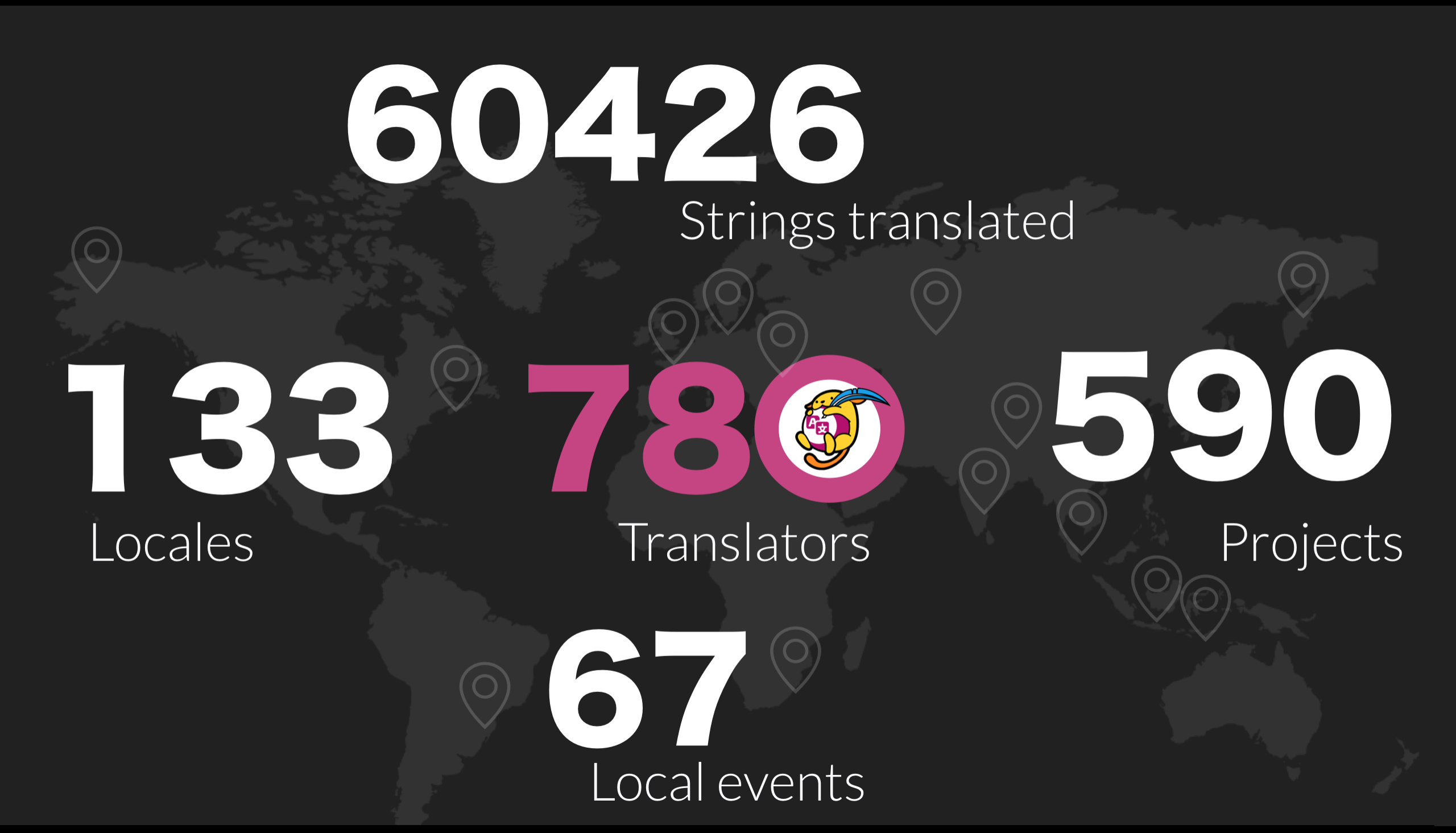
Global WordPress Translation Day 2, or how I’m hoping to start calling it from now on #WPTranslationDay 2 happened last weekend with 740  people all over the world joining and translating 60 000 stringsString A string is a translatable part of the software. A translation consists of a multitude of localized strings. in 133 languages. This is a somewhat long overview I wanted to post here for the people curious about what we did and how.

tldr: It was a great experience, led to amazing results and we’ll do it again, because it keeps increasing our contributor base.

What we did


This slideshow requires JavaScriptJavaScript JavaScript or JS is an object-oriented computer programming language commonly used to create interactive effects within web browsers. WordPress makes extensive use of JS for a better user experience. While PHP is executed on the server, JS executes within a user’s browser. https://www.javascript.com.

How we did it

  • We organised it publiclyin an open spreadsheet so everyone could join
  • We opened a call for speakers this time instead of selecting and inviting all speakers ourselves
  • We scheduled and prepared the live sessions to be streamed on Crowdcast with a session starting every hour
  • We used the WP community channels to reach out to WP organisers around the globe and invite them to join us
  • For some of the live session slots we streamed video from the first GWTD, we streamed my introduction to the team, John’s talk on i18nInternationalization Internationalization (sometimes shortened to I18N , meaning “I - eighteen letters -N”) is the process of planning and implementing products and services so that they can easily be adapted to specific local languages and cultures, a process called localization. This is the process of making software translatable. Information about Internationalization for developers can be found in the Developer’s handbooks. for WP developers and his talk on Character encoding from WCNL just because it was so awesome
  • We had a separate SlackSlack Slack is a Collaborative Group Chat Platform https://slack.com/. The WordPress community has its own Slack Channel at https://make.wordpress.org/chat/ team (WPTranslationDay.Slack.com) to communicate with local organisers and speakers during the day

Sessions

This slideshow requires JavaScript.

Polyglots contributor training:

Development sessions

Community sessions

Gender neutral languages

Thanks to John Parkinson, we also have special community sessions recorded during the day that you can watch on WP.tv:

Stats

For a full overview of the WPTranslationDay 2 stats, please see this spreadsheet. Here are some highlights:

infographicstats

Local events

  • 67 local events for GWTD2 (39 for GWTD1)
  • 33 events in Europe
  • 2 events in Africa
  • 1 event in South America
  • 1 event in North America
  • 30 events in Asia (of which 14 in India and 7 in Japan)

Translated strings

  • 60426 for GWTD 2
  • 40350 for GWTD1

This number is important but it’s also important to note that 235 of the contributors during WP Translation Day were brand new which means that there might have been people who didn’t get to translate but only got training during the day, which is also important.

Number of people translating

  • 740 new people translated strings during the 24h of WP Translation Day 2
  • In comparison 448 took part in WP Translation Day 1

That is still only half of the people who signed up on wptranslationday.org, so I believe with a better email marketing approach we can reach even more people next time

Number of localesLocale Locale = language version, often a combination of a language code and a region code, for instance es_MX denotes Spanish as it’s used in Mexico. A list of all locales supported by WordPress in https://make.wordpress.org/polyglots/teams/ translated

  • 133 locales got new strings translated on November 12th
  • 70 of them got more than 10 strings translated
  • 30 of them got more than 500 strings translated
  • In comparison, WP Translation Day 1 saw activity for 54 locales so 133 is an impressive number
  • 31 of our current locales did not get any activity during the day – a note to do a better job reaching out to them

Most active locales

Ja (9716), es (6176), de formal and informal (5662), it (5270), tr (4362), ru (4308), sr (4257), bg (3181), mr (1287), sk (1220), lo (1178)

See the LocaleLocale Locale = language version, often a combination of a language code and a region code, for instance es_MX denotes Spanish as it’s used in Mexico. A list of all locales supported by WordPress in https://make.wordpress.org/polyglots/teams/ stats on the spreadsheet for a detailed report on each locale

Number of projects who got new strings translated: 590

Lessons learned:

General

What we did well:

  • The stats are amazing and there is growth in each aspect of the event – from number of local events to translated strings, to locales that got new translations and number of new translators
  • The live streaming gave us a chance to see each other and that made the feeling a great one overall
  • WordPress 4.7 got a huge boost thanks to the day – the focus on the project helped a lot of local events concentrate on a single thing to translate

What we can improve

  • The next WPTranslationDay needs an organising team from the start
  • Documentation for organisers could have been centralised and more neat
  • We should do a better job in reaching out to organisers and participants in the first two Translation Days
  • Connecting local events with the General Translation EditorsTranslation Editor Translation editors can approve translations for projects. The GTE (General Translation Editor) and LM (Locale Manager) roles can add new users with the "Project Translation Editor" role that can approve translations for specific projects. There are two different Translation Editor roles: General Translation Editor and Project Translation Editor for the languages they’ll be translating in is important

Communication/marketing

What we did well:

  • We managed to reach out to many more organisers thanks to the active involvement of Naoko and Mayuko in Asia
  • We reached out to local organisers through the community team’s channels on time (Thank you, Josepha, for sending out that email)
  • We didn’t have to spend so much time on the website this time because we already had the base from the first event
  • We had a lot of the organisers posting on their RosettaRosetta The code name of the theme for the local WordPress sites (eg. bg.wordpress.org is a “Rosetta” site). All locale specific WordPress sites are referred to as “Rosetta sites.” The name was inspired from the ancient Rosetta Stone, which contained more or less the same text in three different languages. sites

What we can improve

  • We had too many different places we were sending people to:
    • Organisers to a spreadsheet, the website and the live streaming event
    • Attendees to both wptranslationday.org, the Polyglots blog (for potential organisers) and Crowdcast (also the Facebook event and the local Facebook events)
  • We need to find a way to help local organisers post on their Rosetta sites – perhaps a sample post can be automatically drafted in all Rosetta sites and we can ask editors to just post and translate
  • We can create a FB event earlier and figure out to feature all local events there so people actively using FB can find their event easier
  • We need a marketing team and a content plan
  • The live streaming can use better promotion on all channels – I managed to do some speaker cards on twitter but we can do that a lot earlier next time to gain more subscribers for the live streaming sessions
  • We have a huge base of people who signed up for the event which we couldn’t email because I couldn’t find a right way to do it:
    • We don’t have a centralised way to contact people
    • A mail chimp account needed a valid “from” email address and I didn’t feel it was right to put my own there as it would have seemed scummy
    • Mentioning all event organisers on the make/polyglots P2p2 "p2" is the name of the theme that blogs at make.wordpress.org use (and o2 is the accompanying plugin). When asked to post something "on the p2" by a member of the Polyglots team, that usually means you're asked to post on the team blog https://make.wordpress.org/polyglots/. was a bit extreme but worked quite well for communication
    • We needed more people to help with the communication campaign – some sessions were not promoted well enough
    • We could have used some more training content “How to translate WordPress in…” not enough people did sessions during the day and some areas (languages) are still not covered

Live sessions

What we did well:

  • Panels and community sessions were a great idea and everyone enjoyed them
  • We had new people give sessions on interesting, important topics
  • The development sessions were great and generated a lot of interest

What we can improve

  • We couldn’t fill out all the speakers slots, some more attention there would help us cover important topics that we did not this time like:
    • Advanced tools for GTEs and PTEs
    • How to find translators and work with the polyglots community – a session for developers
  • We didn’t have enough time for each speaker to do a trial run with slides and some speakers had technical issues. With more people and a dedicated speakers team that can be avoided
  • The community sessions were a bit hectic and can use a bit more structure – trial runs with people wishing to jump on screen would also be good.

I’m really grateful that I have the opportunity to organise events like this for the Polyglots community.

The most important statistic is that Since GWTD 1 in April, the translation contributors have increased from 10000 to 17000. That means more people are translating than ever.

Thank you

I’d like to thank everyone who helped put the event together! To all local organisers and everyone who helped a new contributor find their way across our platform and start translating. A special thank you to all our speakers, to SiteGround, who hosted our site and to Human Made for covering the CrowdCast cost for the event.

And last but not least, thank you to all 700+ people who translated last Saturday.

Thank you. You are incredible 🌻


#events, #wptd, #wptd2

WP Translation Day organisers FAQ

Dear #WPTranslationDay event organisers,

The event is coming this Saturday and on behalf of the whole team, I’d like to say thank you for doing this for the global community and for your local community too. WP Translation Day is our global contributor dayContributor Day Contributor Days are standalone days, frequently held before or after WordCamps but they can also happen at any time. They are events where people get together to work on various areas of https://make.wordpress.org/ There are many teams that people can participate in, each with a different focus. https://make.wordpress.org/support/handbook/getting-started/getting-started-at-a-contributor-day/, a chance to spend time together, get to know each other and give back to WordPress. It wouldn’t be possible without you all. You are amazing.

Here is a list of useful tips and frequently asked questions for you. Read it carefully, it has information that’s important for you. If you want to ask anything else, please do it in the #Polyglots channel on SlackSlack Slack is a Collaborative Group Chat Platform https://slack.com/. The WordPress community has its own Slack Channel at https://make.wordpress.org/chat/ or in the #Event-organisers channel on the WPTranslationDay Slack.

How should I start the day?

Start your day by explaining to the people at your event how the Polyglots teamPolyglots Team Polyglots Team is a group of multilingual translators who work on translating plugins, themes, documentation, and front-facing marketing copy. https://make.wordpress.org/polyglots/teams/ runs. If you don’t have experience, this slide deck will give you all the information you need: View and download Presentation: Introduction to the WordPress Polyglots team

Where can I look if I need information about the team?

The Polyglots handbook is your best friend. You will find an answer to almost any question you have on https://make.wordpress.org/polyglots/handbook/

What are the first things new contributors should do during the day?

Here’s a list of things you need to help new contributors with:

  1. Register an account on WordPress.org
  2. Sign into Slack with their new account from http://chat.wordpress.org and join the #Polyglots
  3. Login to http://translate.wordpress.org, find their language and translate

Check out the First steps and Getting started at contributor day handbook pages for more instruction.

Which project should we translate?

Start with WordPress 4.7 development stringsString A string is a translatable part of the software. A translation consists of a multitude of localized strings. and Twenty Seventeen. Our primary goal for this WP Translation Day is to prepare 4.7 for launch.

When these are done, advise your attendees to start translating a pluginPlugin A plugin is a piece of software containing a group of functions that can be added to a WordPress website. They can extend functionality or add new features to your WordPress websites. WordPress plugins are written in the PHP programming language and integrate seamlessly with WordPress. These can be free in the WordPress.org Plugin Directory https://wordpress.org/plugins/ or can be cost-based plugin from a third-party. or a theme they are using – it’s always better for them to start with a project they’re familiar with

Where is the Glossary/Style guide for my language?

If your locale has a Glossary or Style guide published, it will be listed on this page: Glossaries and style guides per locale

If your locale doesn’t have a glossary or a style guide, please refer to the General Expectations when translating: https://make.wordpress.org/polyglots/handbook/translating/expectations/. You can also look up glossaries of your language by other Open SourceOpen Source Open Source denotes software for which the original source code is made freely available and may be redistributed and modified. Open Source **must be** delivered via a licensing model, see GPL. projects like GNU or Mozilla.

Where can I find the WP TranslationDay Live streaming?

There will be live sessions during translation day on i18nInternationalization Internationalization (sometimes shortened to I18N , meaning “I - eighteen letters -N”) is the process of planning and implementing products and services so that they can easily be adapted to specific local languages and cultures, a process called localization. This is the process of making software translatable. Information about Internationalization for developers can be found in the Developer’s handbooks. & L10nLocalization Localization (sometimes shortened to "l10n") is the process of adapting a product or service to a particular language, culture, and desired local "look-and-feel.". The live streaming starts at 0:00 UTC. You can stream it live in your event and it would be lovely if you appeared in one of our community sessions and joined lived from your meetupMeetup All local/regional gatherings that are officially a part of the WordPress world but are not WordCamps are organized through https://www.meetup.com/. A meetup is typically a chance for local WordPress users to get together and share new ideas and seek help from one another. Searching for ‘WordPress’ on meetup.com will help you find options in your area.. See the schedule at https://www.crowdcast.io/e/gwtd2/1 and contact us if you’d like to jump in during the live session.

How can I share what’s going on during my event?

We gather all the social buzz on https://wptranslationday.org/real-time/ so use the hashtag #WPTranslationDay for your pictures and tweets you share and they will appear on the page. We would love to see images, video and info from your local event. The page should aggregate content from all social networks.

What is the hashtag again?

#WPTranslationDay

Where should I ask if there’s something I don’t know?

As an event organiser, we highly recommend for you to be in the #Polyglots Slack channel during the day. If you haven’t signed up for Slack yet, please do at http://chat.wordpress.org

Continue reading

#events, #local-events, #wptd, #wptd2

Help us validate 5 WooCommerce extensions in 24 locales

Thanks to GoDaddy’s initiative to support localizationLocalization Localization (sometimes shortened to "l10n") is the process of adapting a product or service to a particular language, culture, and desired local "look-and-feel." of WordPress plugins & themes, we at Automattic received translations of 5 plugins in 24 localesLocale Locale = language version, often a combination of a language code and a region code, for instance es_MX denotes Spanish as it’s used in Mexico. A list of all locales supported by WordPress in https://make.wordpress.org/polyglots/teams/.

  1. WooCommerce
  2. Storefront Product Pagination
  3. Storefront Product Sharing
  4. Storefront Sticky Add to Cart
  5. WooCommerce Gateway Stripe

Validation process (2 options)

There are two ways you can use the translation files we have.

1. Review the translation using the PO files, then import them (you will receive credits).

OR

2. Review Waiting stringsString A string is a translatable part of the software. A translation consists of a multitude of localized strings. on translate.wordpress.orgtranslate.wordpress.org The platform for contributing to the translation of WordPress core, themes and plugins.. I will import everything in one week (in case GTEs prefer the method 1) as Waiting status.

  • Please feel free to leave a comment if you want the import to happen sooner for your localeLocale Locale = language version, often a combination of a language code and a region code, for instance es_MX denotes Spanish as it’s used in Mexico. A list of all locales supported by WordPress in https://make.wordpress.org/polyglots/teams/.
  • If you don’t have time to validate, the translations will just stay as “Waiting”. There is no time limit to review them.

Locales

Note to validators

  • There may not be all 5 translation files for your locale. That’s because some of the plugins are 100% completed already.
  • Preparing these files involved a bit of manual work on my side, so if you see any technical flaws it’s probably my fault. Please don’t hesitate to point them out, and I’d be glad to fix/investigate the cause.
  • Thanks in advance for your help!

A guide to your Global WordPress Translation Day Local event

Hey everyone,

As you all know, Global WordPress Translation Day 2 is coming on November 12th. We invite everyone involved with the Polyglots teamPolyglots Team Polyglots Team is a group of multilingual translators who work on translating plugins, themes, documentation, and front-facing marketing copy. https://make.wordpress.org/polyglots/teams/ to consider organising or taking a part in a small local meetupMeetup All local/regional gatherings that are officially a part of the WordPress world but are not WordCamps are organized through https://www.meetup.com/. A meetup is typically a chance for local WordPress users to get together and share new ideas and seek help from one another. Searching for ‘WordPress’ on meetup.com will help you find options in your area. dedicated to translating. This is what we call “Local events” and in April we had more than 40 organised in different parts of the world.

I thought I could share some tips on how to organise your local event for those of you who feel hesitant or think it takes special knowledge or experience. It doesn’t really – you can just gather a couple of people with their laptops in a cafe for two hours and who them translate.wordpress.orgtranslate.wordpress.org The platform for contributing to the translation of WordPress core, themes and plugins. – that will be enough 🙂

Here are a few more structured ideas:

Organise your local event:

  • Pick a place (it can be your office, a coffee shop with wifi connection or a co-working space – choose whichever is easiest)
  • Create a Facebook or a meetup.com event and invite people
  • Publish the information about your event on your RosettaRosetta The code name of the theme for the local WordPress sites (eg. bg.wordpress.org is a “Rosetta” site). All locale specific WordPress sites are referred to as “Rosetta sites.” The name was inspired from the ancient Rosetta Stone, which contained more or less the same text in three different languages. site (if you don’t have access, pingPing The act of sending a very small amount of data to an end point. Ping is used in computer science to illicit a response from a target server to test it’s connection. Ping is also a term used by Slack users to @ someone or send them a direct message (DM). Users might say something along the lines of “Ping me when the meeting starts.” us in the comments and we’ll make sure we connect you to the right people). There is a template with an announcement you can use, you can find it here.

On the day of the event:

  • Start by introducing the Polyglots team and what we do. If you have a room with a projector, here is a sample presentation in English that you can translate to your language with the basics: Download.
  • Get everyone registered on WordPress.orgWordPress.org The community site where WordPress code is created and shared by the users. This is where you can download the source code for WordPress core, plugins and themes as well as the central location for community conversations and organization. https://wordpress.org/
  • Get everyone on SlackSlack Slack is a Collaborative Group Chat Platform https://slack.com/. The WordPress community has its own Slack Channel at https://make.wordpress.org/chat/ and get them to join the #Polyglots channel
  • Introduce them to http://translate.wordpress.org and show them how to use it
  • Get everyone to pick one of their favourite plugins or themes and start translating it into their language

Some handbook pages that can help you!

Share pictures and videos from your event

  • On the day, we will be using the website http://wptranslationday.org to show everything shared on Twitter with the hashtag #WPTranslationDay coming from around the world
  • We would love it if you got the people around you to tweet videos and images from your event – it will be a great way to feel you’re a part of the global initiative.

Once you decide you want to organise an event, please make sure you’ve gone through the following steps:

If you have any questions at all, please don’t hesitate to ask them in the comments or on Slack.

Cheers!

Petya

#events, #gwtd, #local-events, #translation-day

New Team o2s

Two weeks ago we’ve rolled out 11 team o2s for testing. Today we’re pleased to announce that all 71 locales with a current release now have a team o2p2 "p2" is the name of the theme that blogs at make.wordpress.org use (and o2 is the accompanying plugin). When asked to post something "on the p2" by a member of the Polyglots team, that usually means you're asked to post on the team blog https://make.wordpress.org/polyglots/..

What should you use the o2 for?

A team o2 can be used for whatever your local community needs. For example, you can use it to talk about WordCamps, meetups, translations, support, documentation, meeting summaries, discussions about new ideas and the likes – in your language.

It can be a great platform for new people who would like to join your translation team. Or a great place to post about upcoming events and invite people to suggest topics. Basically, it’s an open wall for your community to discuss local issues. An official one, on your official local WordPress.orgWordPress.org The community site where WordPress code is created and shared by the users. This is where you can download the source code for WordPress core, plugins and themes as well as the central location for community conversations and organization. https://wordpress.org/ site.

How does your team get an o2?

Every RosettaRosetta The code name of the theme for the local WordPress sites (eg. bg.wordpress.org is a “Rosetta” site). All locale specific WordPress sites are referred to as “Rosetta sites.” The name was inspired from the ancient Rosetta Stone, which contained more or less the same text in three different languages. site should have one and every team can get one. If your localeLocale Locale = language version, often a combination of a language code and a region code, for instance es_MX denotes Spanish as it’s used in Mexico. A list of all locales supported by WordPress in https://make.wordpress.org/polyglots/teams/ is currently released for 4.6, your o2 is already created. You can check if you have one by adding “/team” to the address of your Rosetta site. If you don’t already have one, please feel free to request one in a comment below this post.

The following 60 62 sites were created:

team-site

  • #ary: https://ary.wordpress.org/team/
  • #az: https://az.wordpress.org/team/
  • #bn_BD: https://bn.wordpress.org/team/
  • #bo: https://bo.wordpress.org/team/
  • #ca: https://ca.wordpress.org/team/
  • #cs_CZ: https://cs.wordpress.org/team/
  • #cy: https://cy.wordpress.org/team/
  • #da_DK: https://da.wordpress.org/team/
  • #de_CH: https://de-ch.wordpress.org/team/
  • #el: https://el.wordpress.org/team/
  • #en_AU: https://en-au.wordpress.org/team/
  • #en_CA: https://en-ca.wordpress.org/team/
  • #en_GB: https://en-gb.wordpress.org/team/
  • #en_NZ: https://en-nz.wordpress.org/team/
  • #en_ZA: https://en-za.wordpress.org/team/
  • #eo: https://eo.wordpress.org/team/
  • #es_AR: https://es-ar.wordpress.org/team/
  • #es_CL: https://cl.wordpress.org/team/
  • #es_GT: https://es-gt.wordpress.org/team/
  • #es_MX: https://es-mx.wordpress.org/team/
  • #es_PE: https://pe.wordpress.org/team/
  • #es_VE: https://ve.wordpress.org/team/
  • #eu: https://eu.wordpress.org/team/
  • #fa_IR: https://fa.wordpress.org/team/
  • #fi: https://fi.wordpress.org/team/
  • #fr_BE: https://fr-be.wordpress.org/team/
  • #fr_CA: https://fr-ca.wordpress.org/team/
  • #gd: https://gd.wordpress.org/team/
  • #gl_ES: https://gl.wordpress.org/team/
  • #gu: https://gu.wordpress.org/team/
  • #hau: https://hau.wordpress.org/team/
  • #hi_IN: https://hi.wordpress.org/team/
  • #hr: https://hr.wordpress.org/team/
  • #hu_HU: https://hu.wordpress.org/team/
  • #hy: https://hy.wordpress.org/team/
  • #id_ID: https://id.wordpress.org/team/
  • #is_IS: https://is.wordpress.org/team/
  • #ka_GE: https://ka.wordpress.org/team/
  • #km: https://km.wordpress.org/team/
  • #ko_KR: https://ko.wordpress.org/team/
  • #lt_LT: https://lt.wordpress.org/team/
  • #lv: https://lv.wordpress.org/team/
  • #mr: https://mr.wordpress.org/team/
  • #ms_MY: https://ms.wordpress.org/team/
  • #nb_NO: https://nb.wordpress.org/team/
  • #nn_NO: https://nn.wordpress.org/team/
  • #oci: https://oci.wordpress.org/team/
  • #pl_PL: https://pl.wordpress.org/team/
  • #pt_PT: https://pt.wordpress.org/team/
  • #ro_RO: https://ro.wordpress.org/team/
  • #sk_SK: https://sk.wordpress.org/team/
  • #sl_SI: https://sl.wordpress.org/team/
  • #sq: https://sq.wordpress.org/team/
  • #sr_RS: https://sr.wordpress.org/team/
  • #sv_SE: https://sv.wordpress.org/team/
  • #szl: https://szl.wordpress.org/team/
  • #te: https://te.wordpress.org/team/
  • #th: https://th.wordpress.org/team/
  • #tr_TR: https://tr.wordpress.org/team/
  • #uk: https://uk.wordpress.org/team/
  • #vi: https://vi.wordpress.org/team/
  • #zh_TW: https://tw.wordpress.org/team/

How does o2 work?

A new handbook page “Team o2” has been added to provide some details about the new site, how to manage and use it. Read it and ask any questions that remain in the comments here.

Who has access to the new o2s?

All locale managers get an Editor level access to the new o2s which allows them to customize the site and moderate content. o2s are separate WordPress installs from your Rosetta site, but all your current Locale Managers and Editors are added as users by default. All WordPress.org users can post and comment on locale o2s.

We’re delighted to finally be able to add this feature for all teams and we hope you find it useful to get new contributors and make communication about contributing to WordPress easier in your language.

#announcement, #dev-update

#rosetta

Polyglots at the first WordCamp Riga contributor day

Hey lovelies,

I thought I’d give a quick recap of the first WordCampWordCamp WordCamps are casual, locally-organized conferences covering everything related to WordPress. They're one of the places where the WordPress community comes together to teach one another what they’ve learned throughout the year and share the joy. Learn more. Riga contributor dayContributor Day Contributor Days are standalone days, frequently held before or after WordCamps but they can also happen at any time. They are events where people get together to work on various areas of https://make.wordpress.org/ There are many teams that people can participate in, each with a different focus. https://make.wordpress.org/support/handbook/getting-started/getting-started-at-a-contributor-day/ and what it meant for the Polyglots teamPolyglots Team Polyglots Team is a group of multilingual translators who work on translating plugins, themes, documentation, and front-facing marketing copy. https://make.wordpress.org/polyglots/teams/.

It was a pleasure meeting @orvils, one of the Latvian GTEs, in person as well as many other new translation contributors who worked on pluginPlugin A plugin is a piece of software containing a group of functions that can be added to a WordPress website. They can extend functionality or add new features to your WordPress websites. WordPress plugins are written in the PHP programming language and integrate seamlessly with WordPress. These can be free in the WordPress.org Plugin Directory https://wordpress.org/plugins/ or can be cost-based plugin from a third-party. translations to Latvian, but also German 🙂

Thank you, everyone, who participated. Here are a few things we did (besides teaching everyone how to translate and translating) and a few that remain on my ToDo list to follow up on:

  • We created a Latvian Team O2 🎉 https://lv.wordpress.org/team/
  • We got the new contributors to join the WordPress SlackSlack Slack is a Collaborative Group Chat Platform https://slack.com/. The WordPress community has its own Slack Channel at https://make.wordpress.org/chat/ team (thanks @ocean90 with your help there, Slack was not keen to send many invites today)
  • We planned adding the Latvian glossary to the Handbook page (attention @mte90, you might want to add it to GlotDict)
  • We planned to add the Latvian Slack team to the Local Slacks handbook page once they change their name and url from WordCampRiga to WordPressLatvia (attn @kristianastala)
  • We talked about the Latvian team potentially organising a meetupMeetup All local/regional gatherings that are officially a part of the WordPress world but are not WordCamps are organized through https://www.meetup.com/. A meetup is typically a chance for local WordPress users to get together and share new ideas and seek help from one another. Searching for ‘WordPress’ on meetup.com will help you find options in your area. for WP Translation Day

Apart from the Riga related tasks, a few more things I managed to do today:


This slideshow requires JavaScriptJavaScript JavaScript or JS is an object-oriented computer programming language commonly used to create interactive effects within web browsers. WordPress makes extensive use of JS for a better user experience. While PHP is executed on the server, JS executes within a user’s browser. https://www.javascript.com.

Thanks everyone who joined, really loved working with you today <3

@orvils @edzuss99 @frankleusing @kristianastala @muxahuk1214 @unigunde @frankleusing @armandsdz @peteris and everyone else!


#contributor-day, #event-recap, #events, #local-events, #polyglots

Global WordPress Translation Day 2 on November 12th, 2016

The first Global WordPress Translation Day was so much fun and made a real difference for us as a global team. That’s why on November 12th, we’re doing it again and everyone can join!

What are we doing?

  • Local translation contributor days – as many as possible (last time we had more than 50, let’s beat that!)
  • Remote events for as many languages as possible to support contributors who would like to join from their home
  • 24 hours of live streaming sessions about localizationLocalization Localization (sometimes shortened to "l10n") is the process of adapting a product or service to a particular language, culture, and desired local "look-and-feel." and internationalizationInternationalization Internationalization (sometimes shortened to I18N , meaning “I - eighteen letters -N”) is the process of planning and implementing products and services so that they can easily be adapted to specific local languages and cultures, a process called localization. This is the process of making software translatable. Information about Internationalization for developers can be found in the Developer’s handbooks. (L10nLocalization Localization (sometimes shortened to "l10n") is the process of adapting a product or service to a particular language, culture, and desired local "look-and-feel." and i18nInternationalization Internationalization (sometimes shortened to I18N , meaning “I - eighteen letters -N”) is the process of planning and implementing products and services so that they can easily be adapted to specific local languages and cultures, a process called localization. This is the process of making software translatable. Information about Internationalization for developers can be found in the Developer’s handbooks.).

Who are the sessions for?

  • New contributors who would like to learn how to translate WordPress in their language
  • New and experienced translation editorsTranslation Editor Translation editors can approve translations for projects. The GTE (General Translation Editor) and LM (Locale Manager) roles can add new users with the "Project Translation Editor" role that can approve translations for specific projects. There are two different Translation Editor roles: General Translation Editor and Project Translation Editor – the sessions will have useful tips and advice how to build and maintain a strong translation team
  • Developers who would like to find translators for their projects – the sessions will teach you how to work with the polyglots teamPolyglots Team Polyglots Team is a group of multilingual translators who work on translating plugins, themes, documentation, and front-facing marketing copy. https://make.wordpress.org/polyglots/teams/ and how to build a translation community around your products
  • Developers who would like to learn how to prepare their plugins and themes for localization
  • Everyone who would like to learn how translations work in WordPress and get a general idea of the work of the Polyglots team.

When is it happening?

On November 12th, 2016, starting at exactly 0:00 UTC.

See when the event starts for you!

Why are we doing it?

  • To have fun and get to know each other better.
  • To encourage more translation contributors to get involved and expand the WordPress Polyglots team
  • To improve the general understanding of how WordPress deals with translations among the development community
  • To create strong connections between the pluginPlugin A plugin is a piece of software containing a group of functions that can be added to a WordPress website. They can extend functionality or add new features to your WordPress websites. WordPress plugins are written in the PHP programming language and integrate seamlessly with WordPress. These can be free in the WordPress.org Plugin Directory https://wordpress.org/plugins/ or can be cost-based plugin from a third-party. and theme authors and the WordPress translation community

How can you join?

Please also comment below if you’d like to get involved but are not sure how. We’ll help you out!

That’s it for now. Let’s make the second one even better.

Cheers!

Petya

P.S Important links:

#global-wordpress-translation-day-2, #gwtd, #translate-wordpress, #translation-day

#events

Behind one or two major versions – releasing 95%+ locales for WordPress 4.6

Hey everyone,

It’s been a week since 4.6 and it’s amazing that we’ve got 60 localesLocale Locale = language version, often a combination of a language code and a region code, for instance es_MX denotes Spanish as it’s used in Mexico. A list of all locales supported by WordPress in https://make.wordpress.org/polyglots/teams/ released for it. I’d like to suggest that we release the 95% + locales as well, especially those who are behind more than one major version.

If you’re receiving this post in an email, you’re a Global Translation EditorTranslation Editor Translation editors can approve translations for projects. The GTE (General Translation Editor) and LM (Locale Manager) roles can add new users with the "Project Translation Editor" role that can approve translations for specific projects. There are two different Translation Editor roles: General Translation Editor and Project Translation Editor for one of these locales. Please follow the instructions for a manual release in the handbook to create a package for your language.

Locales Behind more than one major versions

NB! That means your translation is inactive and your language IS NOT available for download or select on install anymore! A manual release is highly encouraged.

When a translation goes behind more than one major version it disappears for new users. That’s why it is highly recommended that locales translated 90%+ and previously active release now even though their translations need a bit more work to get to 100%. I’m including three locales at 85% + as well.

Behind one major version – recommended release

If you have any questions regarding the manual release, please post them as a comment here or pingPing The act of sending a very small amount of data to an end point. Ping is used in computer science to illicit a response from a target server to test it’s connection. Ping is also a term used by Slack users to @ someone or send them a direct message (DM). Users might say something along the lines of “Ping me when the meeting starts.” the #Polyglots channel on Slack to get some help.

Thank you in advance and shout out if need a hand <3

P.S. Completing your translations to 100% will trigger an automatic release for most of these locales so that’s another way of releasing if you’re not keen to go for the manual process.

#inactive-locales, #inactive-translations, #release

August Handbook (documentation) sprint – call for volunteers

Hey everyone,

WordPress 4.6 is coming on August 16th and the week of, and after, a release, are usually busy times for us here on make/polyglots, as we’re trying to get the new stringsString A string is a translatable part of the software. A translation consists of a multitude of localized strings. to as many people as possible.

These are also the periods where more new contributors are drawn to the project and documentation comes in handy.

That’s why I’d like to organise two August polyglots documentation sprints with two main goals:

  1. Clean old, irrelevant content from the handbook at https://make.wordpress.org/polyglots/handbook/
    • Check for incorrect information
    • Check for outdated information that’s no longer irrelevant
    • Replace old screenshots with new ones where UIUI UI is an acronym for User Interface - the layout of the page the user interacts with. Think ‘how are they doing that’ and less about what they are doing./design has changed
  2. Test for focus groups and figure out what content we’re missing for our main target groups:
    • New translation contributors
      • Getting started
      • Registering an account
      • Working with translate.wordpress.orgtranslate.wordpress.org The platform for contributing to the translation of WordPress core, themes and plugins.
      • Understanding the contributor hierarchy (roles)
      • Finding local glossary/style guide
      • Getting in touch with GTEs
    • Translation EditorsTranslation Editor Translation editors can approve translations for projects. The GTE (General Translation Editor) and LM (Locale Manager) roles can add new users with the "Project Translation Editor" role that can approve translations for specific projects. There are two different Translation Editor roles: General Translation Editor and Project Translation Editor and General Translation Editors
      • Requesting a new localeLocale Locale = language version, often a combination of a language code and a region code, for instance es_MX denotes Spanish as it’s used in Mexico. A list of all locales supported by WordPress in https://make.wordpress.org/polyglots/teams/
      • Inactive translations/ becoming a GTEGeneral Translation Editor A General Translation Editor (often referred to as GTE) is a person, who has global access to validate strings on all projects for a specific locale.
      • GTE responsibilities and requirements
      • Creating a Glossary and Style guide
      • Working with translate.wordpress.org
      • Adding other GTEs/PTEs
      • Working with WordPress coreCore Core is the set of software required to run WordPress. The Core Development Team builds WordPress.
      • Releasing translation
        • Manually releasing translations
        • Automatic language packs
    • RosettaRosetta The code name of the theme for the local WordPress sites (eg. bg.wordpress.org is a “Rosetta” site). All locale specific WordPress sites are referred to as “Rosetta sites.” The name was inspired from the ancient Rosetta Stone, which contained more or less the same text in three different languages. site maintainers
      • Translating the interface
      • Setting up basic pages
      • Localized PluginPlugin A plugin is a piece of software containing a group of functions that can be added to a WordPress website. They can extend functionality or add new features to your WordPress websites. WordPress plugins are written in the PHP programming language and integrate seamlessly with WordPress. These can be free in the WordPress.org Plugin Directory https://wordpress.org/plugins/ or can be cost-based plugin from a third-party. and Theme Directories
      • Showcase – how to and best practices, also rules and examples
      • Creating content for the Blog – ideas for different types of content and examples
      • Adding a “Get involved” page – (template + examples)
    • Local support forumSupport Forum WordPress Support Forums is a place to go for help and conversations around using WordPress. Also the place to go to report issues that are caused by errors with the WordPress code and implementations. moderators
      • General expectations
      • Translating the interface
      • Adding new moderators
    • Plugin/theme authors wondering how to get their project successfully localized on translate.wordpress.org
      • Requesting translations for their projects
      • Requesting Project translation editors
      • Translation options for plugin authors – import vs using community translations
      • Cross locale PTEs
      • Releasing translations (language packs)
      • Working with the translation community

If someone would like to get involved with working on these tasks and adding / updating content for current pages (here’s the updated Content spreadsheet), please say so in the comments so we can plan the sprint.

Cheers!

Petya

Subtitles for the 4.6 Release Video

Dear polyglots,

The WordPress 4.6 release video is being finalised as we speak but the voice over is already available for translation, so let’s get this going and translate it to as many languages as we can. The 4.5 release video was subtitled into 31 languages but I know we can do better than that 🙂

Here are the instructions to subtitle the video:

1. Open the release video project on Amara

2. To add your language click “Add a new language”

3. Select your language. This will load the subtitle editor.

4. On the left side of the subtitle editor you’ll see the English subtitles. On the right side you can translate into your own language. Follow the instructions to add the subtitles and sync them.

5. Add the translations to your language, sync them and don’t forget to

6. Save and Publish the subtitles.

If your language’s language code is not supported by Amara, you can add the subtitle file here and we will try and add them manually to WordPress.tv.

Our jazz legend is male.

The deadline for translating the video is Monday, Aug 15th, midnight CET.

Thank you to everyone who’ll help us get the release video to more people around the world.

Love,

P.

#release, #subtitles

WordPress 4.6 soft string freeze – time to translate (almost) all the things!

Dear polyglots,

As of a few minutes ago, we’re in soft string freezeString freeze The term "string freeze" is used by the core team to mark the end of changes to the strings of an upcoming release. A string freeze also means that there will be no more strings added to the core project. Sometimes a string freeze has two phases a soft freeze and a hard freeze. A string freeze is announced on the Polyglots blog by the current release lead., which means all the stringsString A string is a translatable part of the software. A translation consists of a multitude of localized strings. for the upcoming WordPress 4.6 release with the exception of the strings from the About page, are frozen and won’t be changed.

The release is scheduled for August 16th, so we recommend that you use the time between now and the hard string freeze (expected on August 5th), to translate and test translation for everything that is included in the 4.6. development project.

Reminding everyone that for a localeLocale Locale = language version, often a combination of a language code and a region code, for instance es_MX denotes Spanish as it’s used in Mexico. A list of all locales supported by WordPress in https://make.wordpress.org/polyglots/teams/ to take advantage of the automatic release process all these projects – WordPress, WordPress Administration , WordPress Network administration and Continents & Cities need to be 100% translated.

Don’t miss Continents & cities, it’s not been updated with new strings in a while but now has several new ones!

This is a notification for General translation editorsTranslation Editor Translation editors can approve translations for projects. The GTE (General Translation Editor) and LM (Locale Manager) roles can add new users with the "Project Translation Editor" role that can approve translations for specific projects. There are two different Translation Editor roles: General Translation Editor and Project Translation Editor of all localesLocale Locale = language version, often a combination of a language code and a region code, for instance es_MX denotes Spanish as it’s used in Mexico. A list of all locales supported by WordPress in https://make.wordpress.org/polyglots/teams/ translated at more than 50% as you still have a chance to bring your locales closer to 100 before August 16th.

You will receive an additional notification once we are in hard freezeHard freeze See String freeze. A hard string freeze or a hard freeze is announced when all the strings of the upcoming release are frozen including the strings of the About page. A hard freeze is the final string freeze before a release.. Until then, thank you in advance for your work!

Let’s get 4.6 released with the largest number of 100% translated locales to date 😉

We have 11 locales already at 100% (well done!)

33 locales have more than 95%:

23 locales at more than 90% translated

29 locales translated more than 50%

Happy translating!


#release, #soft-freeze, #string-freeze

A “Translate in locale name” page for all Rosetta sites

I’d like to suggest that we recommend adding a “Translate in [localeLocale Locale = language version, often a combination of a language code and a region code, for instance es_MX denotes Spanish as it’s used in Mexico. A list of all locales supported by WordPress in https://make.wordpress.org/polyglots/teams/ name] page to all RosettaRosetta The code name of the theme for the local WordPress sites (eg. bg.wordpress.org is a “Rosetta” site). All locale specific WordPress sites are referred to as “Rosetta sites.” The name was inspired from the ancient Rosetta Stone, which contained more or less the same text in three different languages. sites that don’t already have one.

I worked with @rabmalin, who recently joined the Nepali team, to help him create a page for ne.wordpress.org.

I have created a general template for the page after that and I think it should be included in the instructions about Rosetta sites in the handbook for all new Editors/General Translation EditorsTranslation Editor Translation editors can approve translations for projects. The GTE (General Translation Editor) and LM (Locale Manager) roles can add new users with the "Project Translation Editor" role that can approve translations for specific projects. There are two different Translation Editor roles: General Translation Editor and Project Translation Editor and GTEs of existing localesLocale Locale = language version, often a combination of a language code and a region code, for instance es_MX denotes Spanish as it’s used in Mexico. A list of all locales supported by WordPress in https://make.wordpress.org/polyglots/teams/ that don’t already have one.

It goes without saying that each  team would have the autonomy to modify/include/exclude content from this page or not use the template at all. But like with the standard slide deck about translating WordPress in your language, it can provide a general guideline for new contributors about communicating their transaltion effots.

The “Translate in [locale name] template for Rosetta sites is available here – anyone can comment.

When reviewing the template, let’s try and answer these questions:

  • Have we included all the necessary content for a new contributor to understand how to get involved. If not, what’s missing?
  • Is the page easy to read/understand (when you think about translating it into your language? Can we improve the phrasing so it can make more sense when translated)

Additionally:

@sam @ocean90 Can we think of an option to add this or a version of it as a default page in a Rosetta site next to the Contact and Welcome pages?

With the current situation, there’s a very slim chance of a site existing without being tied to a Translation project. So I think it makes sense to help new locale maintainers by providing this page by default.

Thoughts?

#rosetta

Contributor Day WCEU 2016 

The WordCampWordCamp WordCamps are casual, locally-organized conferences covering everything related to WordPress. They're one of the places where the WordPress community comes together to teach one another what they’ve learned throughout the year and share the joy. Learn more. Europe was a blast. After two days with great talks, chats and a remarkable party called WCEUball we attended to the Contributor DayContributor Day Contributor Days are standalone days, frequently held before or after WordCamps but they can also happen at any time. They are events where people get together to work on various areas of https://make.wordpress.org/ There are many teams that people can participate in, each with a different focus. https://make.wordpress.org/support/handbook/getting-started/getting-started-at-a-contributor-day/ on Sunday. We’d love to share our achievements with you and for the records.

In the Polyglots meetings of May 11th and May 18th, 2016 the preparations for the WCEU contributor day were on the table. We agreed that we’d identify a couple of goals for the Polyglots teamPolyglots Team Polyglots Team is a group of multilingual translators who work on translating plugins, themes, documentation, and front-facing marketing copy. https://make.wordpress.org/polyglots/teams/ at WordCamp Europe.

So far, 20% of the attendees have “signed up” to help the Polyglots team at WordCamp Europe 2016.
The contributor day organization confirmed these team leads for the Polyglots team:

Additionally, Bego (@pixolin), Francesca (@francina), Raffaella (@zetaraffix), Sergey (@sergey), Luis (@luisrull), Peter (@savione) were there to answer questions and helping to onboard on translations.

Preparation of our goals

To be able to prepare for the contributor day well, we’ll define a couple of goals for the day. They’ll be listed here and explained below.

  • Onboard new translators
  • Translate
  • Find (new) Translation EditorsTranslation Editor Translation editors can approve translations for projects. The GTE (General Translation Editor) and LM (Locale Manager) roles can add new users with the "Project Translation Editor" role that can approve translations for specific projects. There are two different Translation Editor roles: General Translation Editor and Project Translation Editor for localesLocale Locale = language version, often a combination of a language code and a region code, for instance es_MX denotes Spanish as it’s used in Mexico. A list of all locales supported by WordPress in https://make.wordpress.org/polyglots/teams/ that need them
  • FAQ page in the Polyglots handbook
  • Global translation day videos in the Polyglots handbook

Onboard new translators

Lead: Naoko Takano
Assistants: Bego Mario Garde, Denise VanDeCruze

Given the size of the WordCamp Europe 2016 contributor day, it’s highly likely that we’ll have new translators in our team. Our goal is to show them the basics, get them started as a translator, and make sure they leave the day proud of their achievements.

Conditionally the great venue for the Contributor day we had two rooms for the Polyglots team provided.
In one room we could onboard new translators with the help of live presentation via beamer. Bego did a great job and used our prepared slides from the Global WordPress Translation Day to demonstrate how translations and related tasks like approval process, Glossary, and Translation Style Guide are defined and where to find. Nao held a workshop after lunch and talked about translation tips and how to get involved.

While new polyglots got onboarded, the more experienced contributors worked on the translations in their own localeLocale Locale = language version, often a combination of a language code and a region code, for instance es_MX denotes Spanish as it’s used in Mexico. A list of all locales supported by WordPress in https://make.wordpress.org/polyglots/teams/.

Translations in numbers

Over 6495 stringsString A string is a translatable part of the software. A translation consists of a multitude of localized strings. in total were translated, 4587 of those got approved, 1720 had the status “waiting”. Only 17 Strings were rejected which is tremendous in terms of the quality.

We had 71 signups for the translations team on the Contributor Day and the counts above got done by 142 users in total because of many remote working polyglots during the day.

(Thanks for the stats, @ocean90 !)

It’s absolutely awesome! Thank you all very much for that! You rock the game!

Find (new) Translation Editors for locales that need them

We tried to get some more numbers. Following numbers about participants broken down by locale are doubtless incomplete, but they show what we achieved.

Counted participants via announcement on SlackSlack Slack is a Collaborative Group Chat Platform https://slack.com/. The WordPress community has its own Slack Channel at https://make.wordpress.org/chat/ to @CoachBirgit:

  • Finnish (fi): 5
  • Turkish (tr_TR): 1
  • German (de_DE): 7 (+ 4 new translators and 1 PTEProject Translation Editor A Project Translation Editor (often referred to as PTE) is a person, who has access to validate strings on a specific project (for example BuddyPress, WooCommerce or Twenty Fourteen) for one specific locale. A project translation editor can approve strings that are added by translation contributors. Per project translation, editors are appointed by a general translation editor after a request by the project author or by the contributors themselves. gained)
  • Japanese (ja): 1 (+ 2 new translators)
  • Italian (it_IT):5
  • Spanish (es-ES): 3
  • Hungarian (hu_HU): 1
  • Romanian (ro_RO): 1
  • Polish (pl_PL): 1
  • Malayalam (ml_IN): 1
  • Dutch (nl_NL): 2 (+1 new translator)
  • Danish (da_DK): 1
  • Russian (ru_RU): 1
  • Basque (eu): 1
  • Montenegrin (me_ME): 1
  • Dutch (Belgium) (nl_BE): 1
  • French (fr_FR): 1 new translator

We would like to complete this list. Please share your personal achievement at Contributor Day in the comment of this post. And one more request to the existing GTEs – please share your counts, how many new TE or PTE your locale gained on the Contributor day.

FAQ page in the Polyglots handbook

By virtue of the great preparatory work from @casiepa the FAQ draft is now as page transferred to the Polyglots handbooks. So there was no pressure to do this on the contributor day.

Global translation day videos in the Polyglots handbook

During the Global Translation Day, we recorded a fair number (24) videos about helping the polyglots. The more general videos can be included in the handbook, the specific ones on the rosettaRosetta The code name of the theme for the local WordPress sites (eg. bg.wordpress.org is a “Rosetta” site). All locale specific WordPress sites are referred to as “Rosetta sites.” The name was inspired from the ancient Rosetta Stone, which contained more or less the same text in three different languages. sites. We’ll need some people to coordinate and do this. Unfortunately the task leader @francina couldn’t work on this on the Contributor Day. So she created a task list to add the recorded material to the related handbook pages.

Open discussion / round table

The Polyglots mentor team had some topics on the list to discuss.

  1. The Persian situation
  2. Cross PTE trial

Results of this discussion

  1. The requests from Farhad Sakhaei to become one of the GTEGeneral Translation Editor A General Translation Editor (often referred to as GTE) is a person, who has global access to validate strings on all projects for a specific locale. for fa_IR are on the review list from Samuel Sidler. He will mediate between the counterparties. We would appreciate if every discussion on Slack about this topic now stops until the situation is not cleared via escalation process.
  2. We will do a trial for the Cross PTE request. Details will follow in a separate post in the near future when the benchmark data is figured out.

UXUX UX is an acronym for User Experience - the way the user uses the UI. Think ‘what they are doing’ and less about how they do it. Design for GlotPressGlotPress GlotPress is the translation management software that powers Translate.WordPress.org. More information is available at glotpress.org.

Some polyglots participated in the discussions for the UX Design for our beloved (sometimes annoying) translation platform and WordPress pluginPlugin A plugin is a piece of software containing a group of functions that can be added to a WordPress website. They can extend functionality or add new features to your WordPress websites. WordPress plugins are written in the PHP programming language and integrate seamlessly with WordPress. These can be free in the WordPress.org Plugin Directory https://wordpress.org/plugins/ or can be cost-based plugin from a third-party. GlotPress, which was lead by @akirk and @isaackeyet. The GlotPress team did a lot of brainstorming. The results will be posted as soon as possible on blog.glotpress.org.

Words of gratitude

Dear friends, you all did a great job. Please stay tuned with your contributions. An open sourceOpen Source Open Source denotes software for which the original source code is made freely available and may be redistributed and modified. Open Source **must be** delivered via a licensing model, see GPL. project like WordPress needs a lot of love from passionate people like you are.

I thank you so much, I can´t find the right words how impressed I am about our beloved community especially the polyglots!

And I want to thank every single organizer and volunteer that made WCEU an unforgettable event, so THANK YOU!

See you soon – at latest on WordCamp Europe 2017 in Paris!

#event-recap, #events, #wceu, #wordcamp

Cross-Locale PTE Trial

As I briefly mentioned in the last weekly chat, I want to discuss the way we handle importing translations of multiple localesLocale Locale = language version, often a combination of a language code and a region code, for instance es_MX denotes Spanish as it’s used in Mexico. A list of all locales supported by WordPress in https://make.wordpress.org/polyglots/teams/. For the sake of simplicity , I’m only referring to plugins here but this applies to themes as well.

The question is this:

What is the best way for an organization/business with a team of in-house (or hired, third-party) translators to import their PluginPlugin A plugin is a piece of software containing a group of functions that can be added to a WordPress website. They can extend functionality or add new features to your WordPress websites. WordPress plugins are written in the PHP programming language and integrate seamlessly with WordPress. These can be free in the WordPress.org Plugin Directory https://wordpress.org/plugins/ or can be cost-based plugin from a third-party. translations into translate.wordpress.orgtranslate.wordpress.org The platform for contributing to the translation of WordPress core, themes and plugins.?

There was an in-depth discussion on this on SlackSlack Slack is a Collaborative Group Chat Platform https://slack.com/. The WordPress community has its own Slack Channel at https://make.wordpress.org/chat/, in which @matt suggested testing a small number of cross-localeLocale Locale = language version, often a combination of a language code and a region code, for instance es_MX denotes Spanish as it’s used in Mexico. A list of all locales supported by WordPress in https://make.wordpress.org/polyglots/teams/ PTEProject Translation Editor A Project Translation Editor (often referred to as PTE) is a person, who has access to validate strings on a specific project (for example BuddyPress, WooCommerce or Twenty Fourteen) for one specific locale. A project translation editor can approve strings that are added by translation contributors. Per project translation, editors are appointed by a general translation editor after a request by the project author or by the contributors themselves. accounts.

Continue reading

Notes from the Polyglots chat on April 27th

LocaleLocale Locale = language version, often a combination of a language code and a region code, for instance es_MX denotes Spanish as it’s used in Mexico. A list of all locales supported by WordPress in https://make.wordpress.org/polyglots/teams/ stats after the 4.5.1 maintenance release

Releases: 162 localesLocale Locale = language version, often a combination of a language code and a region code, for instance es_MX denotes Spanish as it’s used in Mexico. A list of all locales supported by WordPress in https://make.wordpress.org/polyglots/teams/. 51 locales up to date. 7 locales behind by minor versions. 17 locales behind by one major version. 16 locales behind more than one major version. 62 locales have a site but never released. 9 locales don᾿t have a site.

Translations: 162 locales. 57 locales at 100%. 5 locales have more than 95%. 6 locales have more than 90%. 23 locales have more than 50%. 61 locales have less than 50%. 10 locales don᾿t have a WP project.

  • Taking care of 100% translated locales that haven’t released
    • zh_CH, zh_TW, de_CH, Ja & Cy are behind one minor version even though they’re at 100%
    • de_CH and Ja are about to create the packages.
  • Pinging GTEs of locales that are at 95%+ for manual release
  • Locale stats archive – let’s gather the stats at one place + looking for help to fill the data. There’s a spreadsheet for now – @petya is looking for help to fill it out (search through chat notes, slackSlack Slack is a Collaborative Group Chat Platform https://slack.com/. The WordPress community has its own Slack Channel at https://make.wordpress.org/chat/ logs for locale stats data).

Technical update

  • New version of GlotPressGlotPress GlotPress is the translation management software that powers Translate.WordPress.org. More information is available at glotpress.org.:
  • The performance issue was fixed, right before GWTD! Thanks to @akirk & @barry
  • Also new, for translate.w.org: https://translate.wordpress.org/consistency
  • Translation Sync for pluginPlugin A plugin is a piece of software containing a group of functions that can be added to a WordPress website. They can extend functionality or add new features to your WordPress websites. WordPress plugins are written in the PHP programming language and integrate seamlessly with WordPress. These can be free in the WordPress.org Plugin Directory https://wordpress.org/plugins/ or can be cost-based plugin from a third-party. projects – Previously only new translations were synced between dev<->stable. Since a week or so all edits are also synced.
  • Coming later this day: When a plugin releases a new version all translations will be copied from dev to stable.

Global WordPress Translation Day recap and stats + feedback

Read the recap post: Global WordPress Translation Day – recap &amp; results

We did an amazing job. Impressive stats, great work, everyone.

Feedback:

  • Let’s do it on a Saturday next time, it will help more people get involved as Sunday is considered Family time for everyone
  • Let’s check about a date that doesn’t clash with many international holidays: http://www.timeanddate.com/holidays/
  • Ship cake to all locations (via @francina) and chocolate (via @tacoverdo)
  • Schedule quick broadcasts from different events running throughout the days in between training sessions

NB! If you worked on something specific with your team that can’t be measured via t.w.org, like writing documentation or improving your RosettaRosetta The code name of the theme for the local WordPress sites (eg. bg.wordpress.org is a “Rosetta” site). All locale specific WordPress sites are referred to as “Rosetta sites.” The name was inspired from the ancient Rosetta Stone, which contained more or less the same text in three different languages. site, please add it in the comments of the recap post. Let’s gather everything we did and generate ideas for the next one.

That’s all for this week! 🤗🌻👋

#weekly-meeting-notes, #weekly-meetings