Welcome to the official blog of the translator team for the WordPress open sourceOpen SourceOpen Source denotes software for which the original source code is made freely available and may be redistributed and modified. Open Source **must be** delivered via a licensing model, see GPL. project. This is where we discuss all things related to translating WordPress. Follow our progress for general updates, status reports, and debates.
We’d love for you to help out!
Translate WordPress
You can help translate WordPress to your language by logging in to the translation platform with your WordPress.orgWordPress.orgThe community site where WordPress code is created and shared by the users. This is where you can download the source code for WordPress core, plugins and themes as well as the central location for community conversations and organization. https://wordpress.org/ account and suggesting translations (more details).
We have meetings every week on Slack in polyglots (the schedule is on the sidebarSidebarA sidebar in WordPress is referred to a widget-ready area used by WordPress themes to display information that is not a part of the main content. It is not always a vertical column on the side. It can be a horizontal rectangle below or above the content area, footer, header, or any where in the theme. of this page). You are also welcome to ask questions on the same channel at any time!
Posting here
In order to post to this site, you will need to log in with your wordpress.org account. Your first post may take a while to show up, as it is moderated. Please follow our tag policy when posting.
We did it 🏆 Last weekend was the first ever Global WordPress Translation Day and it happened just as planned and exceeded our expectation about the overall activity. It was a great first event of what I’m hoping we can turn into a regular series so we can get together more often, bring new people on board and improve our processes, documentation and, let’s face it… our contributing experience overall.
What we did
24 hours of live streaming sessions inspired by WordSesh but focused on translation training and developer training on i18nInternationalizationInternationalization (sometimes shortened to I18N , meaning “I - eighteen letters -N”) is the process of planning and implementing products and services so that they can easily be adapted to specific local languages and cultures, a process called localization. This is the process of making software translatable. Information about Internationalization for developers can be found in the Developer’s handbooks. & L10nLocalizationLocalization (sometimes shortened to "l10n") is the process of adapting a product or service to a particular language, culture, and desired local "look-and-feel."
Everything was organised in an open Google Spreadsheet that everyone had access to edit. The ultimate exercise in trust and initiative as everyone could jump on and add information/change/ask questions.
The Website
We are all extremely grateful to Scott Basgaard who allowed us to basically clone the last WordSesh site and change the content, so http://wptranslationday.org is basically WordSesh with our colours and content. The Website allowed us to have a real marketing campaign and in less than 3 weeks we got more than 1300 people to sign up to take part of the event.
24 hours of live streaming sessions
For the live streaming sessions, we used CrowdCast, which worked beautifully and I would highly recommend if we ever decide to do webinars or any online training.
All the videos from the sessions are here: https://www.crowdcast.io/e/wptranslationday/ and will stay available to watch (can also be downloaded). The developer sessions and the translation training will all go on WordPress.TV as well and will be used in various documentation parts of make.wordpress.orgWordPress.orgThe community site where WordPress code is created and shared by the users. This is where you can download the source code for WordPress core, plugins and themes as well as the central location for community conversations and organization. https://wordpress.org/
317 people watched the live streaming sessions
We had live video translation training for 12 languages – Japanese (in that language, by the GTEGeneral Translation EditorA General Translation Editor (often referred to as GTE) is a person, who has global access to validate strings on all projects for a specific locale. team) and a general one for all localesLocaleLocale = language version, often a combination of a language code and a region code, for instance es_MX denotes Spanish as it’s used in Mexico. A list of all locales supported by WordPress in https://make.wordpress.org/polyglots/teams/ in English that I did in the beginning of the day.
There were 22 live sessions overall including development training and translation training, several videos from different WordCamps dedicated to i18n & L10n.
We had several sessions aimed at pluginPluginA plugin is a piece of software containing a group of functions that can be added to a WordPress website. They can extend functionality or add new features to your WordPress websites. WordPress plugins are written in the PHP programming language and integrate seamlessly with WordPress. These can be free in the WordPress.org Plugin Directory https://wordpress.org/plugins/ or can be cost-based plugin from a third-party. and theme developers whether it was to advise them on how to find translators for their themes and plugins or to teach them how to prepare them for L10n
I also want to thank Danielle who jumped on the schedule last minute to wake us up and chat about his great browser extension GlotDict that helps translators get a global Glossary. You can watch the session here. here.
Local events – stand alone contributor days dedicated to translating WordPress
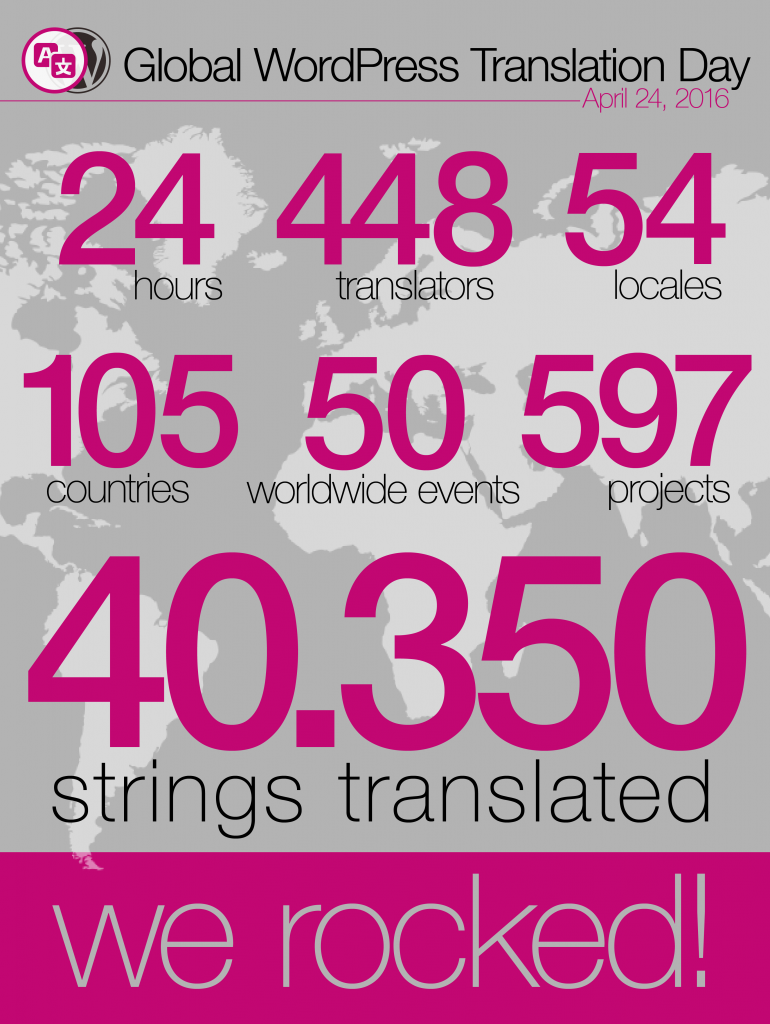
39 local events on 4 continents 🌍🌎🌏
11 remote events in different locations 💻
448 people submitting translations 👏
153 people got a polyglots badge, which means they submitted their first stringsStringA string is a translatable part of the software. A translation consists of a multitude of localized strings. ever during that day! 🎈⭐️❤️
Staring at the top of the pile of strings we translated during the Dutch #wptranslationdaymeetupMeetupAll local/regional gatherings that are officially a part of the WordPress world but are not WordCamps are organized through https://www.meetup.com/. A meetup is typically a chance for local WordPress users to get together and share new ideas and seek help from one another. Searching for ‘WordPress’ on meetup.com will help you find options in your area.! #communitypic.twitter.com/hnC3OJsHTS
As of Monday morning, these are the final stats for the day that Dominik pulled from translate.w.org:
How much got translated 📈
A infographic by Raffaella Isidori
40350 strings translated during the 24 hours
597 projects on translate.wordpress.orgtranslate.wordpress.orgThe platform for contributing to the translation of WordPress core, themes and plugins. had new strings submitted
53 locales got updated with new translations (just for WordPress, not including plugins and themes)
17 new translation editorsTranslation EditorTranslation editors can approve translations for projects. The GTE (General Translation Editor) and LM (Locale Manager) roles can add new users with the "Project Translation Editor" role that can approve translations for specific projects. There are two different Translation Editor roles:
General Translation Editor and Project Translation Editor were added across different locales
15 locales got more than 1000 new strings translated
Who translated the most 🏆
55 locales got contributed to during the 24 hours of the sprint, with 15 locales getting more than 1000 strings in. A stunning 597 projects got new strings translated across all projects (WordPress, Plugins and themes). Here’s the data by localeLocaleLocale = language version, often a combination of a language code and a region code, for instance es_MX denotes Spanish as it’s used in Mexico. A list of all locales supported by WordPress in https://make.wordpress.org/polyglots/teams/:
English (Canada)
en-ca
default
4123
Thai
th
default
3494
Japanese
ja
default
2922
Turkish
tr
default
2899
German
de
default
2896
Bulgarian
bg
default
2655
French
fr
default
2315
Dutch
nl
default
2298
Spanish
es
default
2219
Italian
it
default
1961
German (Formal)
de
formal
1856
Slovak
sk
default
1738
Marathi
mr
default
1171
Malayalam
ml
default
901
Greek
el
default
782
Croatian
hr
default
671
Russian
ru
default
589
Tajik
tg
default
579
Dutch (Formal)
nl
formal
527
Venezuelan Spanish
es-ve
default
451
Afrikaans
af
default
342
Gujarati
gu
default
336
Polish
pl
default
304
Finnish
fi
default
286
Swedish
sv
default
255
Chilean Spanish
es-cl
default
248
Brazilian Portuguese
pt-br
default
192
Spanish (Mexico)
es-mx
default
188
Romanian
ro
default
180
Hindi
hi
default
148
Norwegian (Bokmål)
nb
default
130
Hebrew
he
default
112
Chinese (China)
zh-cn
default
97
Bengali
bn
default
80
Serbian
sr
default
75
Persian
fa
default
50
Lithuanian
lt
default
47
Hungarian
hu
default
34
Kannada
kn
default
33
Albanian
sq
default
30
Tibetan
bo
default
26
Portuguese (Portugal)
pt
default
20
Chinese (Taiwan)
zh-tw
default
18
Tamil
ta
default
15
Javanese
jv
default
12
Asturian
ast
default
8
Turkmen
tuk
default
8
English (UK)
en-gb
default
7
Ukrainian
uk
default
7
Emoji
art-xemoji
default
5
English (Australia)
en-au
default
5
Azerbaijani (Turkey)
az-tr
default
2
Vietnamese
vi
default
2
Czech
cs
default
1
What else did we improve during the day
We got a global list of glossaries and style guides going and it has a lot of resources already
We improved our getting started documentation based on feedback we got
Many teams got new project translation editors and potential General Translation Editors
People from different regions in the same country started talking
We raised awareness about our work across the globe
The Buzz
During the day, the hashtag got updates from 202 accounts, 500 posts were sent that generated 945,251 impressions. See all the pictures and all the buss on the official hashtag #WPTranslationDay. Here’s just a small selection of photos.
This slideshow requires JavaScriptJavaScriptJavaScript or JS is an object-oriented computer programming language commonly used to create interactive effects within web browsers. WordPress makes extensive use of JS for a better user experience. While PHP is executed on the server, JS executes within a user’s browser.
https://www.javascript.com.
Thank you!
I like to thank several people who made this event possible.
Scott Baasgard, for providing the WordSesh site infrastructure and all the WordSesh know-how for our live streaming sessions. Thank you, Scott, this couldn’t have happened without you. A big thank you to SiteGround, who donated the hosting and domain and provided solid support during the event.
Chantal and Nao, who helped me so much with the site and the communication across teams providing tech support, copy for the internal blog posts and constantly had my back when I needed it.
To each and every one of you who submitted a video for our great promo video and helped spread the word about the event after.
To Yana, who edited the video in one night, Hacko and Rob, who fixed bugs and helped me make sense of the different screencast options.
To all of you wonderful GTEs who committed your time to creating a presentation for the day, we’re paving the way to better documentation and more openness in the team, thank you. To all our other wonderful speakers, John, Nikolay, Claudio, Danielle, who did the technical sessions for theme and plugin developers.
To everyone who jumped into the idea and organised a local or a remote event during the day – you were the backbone of this initiative and we couldn’t have done this without you. You are a true inspiration and I’m sure we’ll get even more events next time thanks to your work.
And to Sonja, who stayed up with me for 25 hours providing support, tea, laughs, taking over when needed and who also spend the whole 25 hours translating to German in between taking care of me.
I love how this event brought us all together and I hope you all agree that we should do it again and soon.
How did the day go for you?
Share your impressions. Would you like to do it again? What should we do differently next time? Let’s make it even better.
We have one slot left in the morning, at 05:00 UTC and considering the number of events in India (amazing!), it would be great if we could have 1 or 2 short training sessions for some of the Indian localesLocaleLocale = language version, often a combination of a language code and a region code, for instance es_MX denotes Spanish as it’s used in Mexico. A list of all locales supported by WordPress in https://make.wordpress.org/polyglots/teams/#hi_IN, #mr, #gu, #ml
@gounder @mbigul @gagan0123 @gyan Would any of you (or maybe more than one) like to take on the 05:00 UTC slot and maybe do a live streaming session for the localeLocaleLocale = language version, often a combination of a language code and a region code, for instance es_MX denotes Spanish as it’s used in Mexico. A list of all locales supported by WordPress in https://make.wordpress.org/polyglots/teams/ you’re managing?
From the most downloaded languages currently we’re missing #ar, #ru, #pt_PT, #pt_BR, #zh_CN#zh_TW. There is still time if any of the GTEs would like to get involved – we have a slides template you can use.
Sessions on general L10nLocalizationLocalization (sometimes shortened to "l10n") is the process of adapting a product or service to a particular language, culture, and desired local "look-and-feel.", i18nInternationalizationInternationalization (sometimes shortened to I18N , meaning “I - eighteen letters -N”) is the process of planning and implementing products and services so that they can easily be adapted to specific local languages and cultures, a process called localization. This is the process of making software translatable. Information about Internationalization for developers can be found in the Developer’s handbooks. & Polyglots processes
I’ve included several sessions that are not training in the schedule:
Introduction to the WordPress Polyglots teamPolyglots TeamPolyglots Team is a group of multilingual translators who work on translating plugins, themes, documentation, and front-facing marketing copy. https://make.wordpress.org/polyglots/teams/ – what we do, how we work, roles, processes (basically the first part of the general template with the roles and capabilities handbook page content featured) – Petya
Joan Boluda: On I18n – PluginPluginA plugin is a piece of software containing a group of functions that can be added to a WordPress website. They can extend functionality or add new features to your WordPress websites. WordPress plugins are written in the PHP programming language and integrate seamlessly with WordPress. These can be free in the WordPress.org Plugin Directory https://wordpress.org/plugins/ or can be cost-based plugin from a third-party. Documentation and Support for the Whole World (Video recording from WCEU 2015)
Plugin/Theme authors: How to get your plugin or theme on translate.wordpress.orgtranslate.wordpress.orgThe platform for contributing to the translation of WordPress core, themes and plugins. (needs a speaker, would you like to do it?)
Plugin/Theme Authors: How to find translators for your plugins and themes (needs a speaker, would you like to do it?)
Plugin/Theme Devs: InternationalisationInternationalizationInternationalization (sometimes shortened to I18N , meaning “I - eighteen letters -N”) is the process of planning and implementing products and services so that they can easily be adapted to specific local languages and cultures, a process called localization. This is the process of making software translatable. Information about Internationalization for developers can be found in the Developer’s handbooks. for WordPress developers – the right way to prepare your themes and plugins for translation with John Blackbourn (John was kind enough to accept my invitation to do a live talk on the proper way to prepare your software for L10n)
Yoav Farhi: LocalizationLocalizationLocalization (sometimes shortened to "l10n") is the process of adapting a product or service to a particular language, culture, and desired local "look-and-feel." – Beyond Translation (Video recording from WCEU 2015)
Automatic updates or how WordPress updates translations around releases (hopefully Dominik could do that one)
GlotPressGlotPressGlotPress is the translation management software that powers Translate.WordPress.org. More information is available at glotpress.org. as a Plugin – current state and project roadmap (again, I’m hoping Dominik will have time to pick that one)
Remaining time slots – let’s think about how to fill them
We currently have three remaining 1-hour time slots in the schedule – 5am UTC (I’m hoping one of the Indian L10n teams will take that one), 9pm UTC and 10pm UTC.
There are several things we can do with them:
Play sessions from earlier for people in the later time zones (John’s session, the introduction to the Polyglots team session, How to get translators session)
Switch one of the video recordings to the late slots and do a panel with several GTEs talking about how we manage our local translation teams and comparing best practices.
Do something else – ideas welcome!
You’re up!
Feedback on the schedule, suggestions, comments, questions are much needed! If you see the words “needs a speaker, would you like to do it?” next to a session title, you can pick it up! Please raise your hand. I might be able to do all those, but I don’t want to do them all, there are so many of you that have that knowledge!
Thank you all in avance for your amazing work so far for this event. We have more than 920 people signed up on the site to participate in the initiative. Let’s make it worth their while and show the world what a fantastic job we’re doing.
Organise a 24-hour translation sprint that starts from the East and ends and the most Western parts of the world with three main goals:
Show people who are interested in translating WordPress in their language how to get involved
Translate and validate the waiting stringsStringA string is a translatable part of the software. A translation consists of a multitude of localized strings. for current projects under the supervision of the current General translation editorsTranslation EditorTranslation editors can approve translations for projects. The GTE (General Translation Editor) and LM (Locale Manager) roles can add new users with the "Project Translation Editor" role that can approve translations for specific projects. There are two different Translation Editor roles:
General Translation Editor and Project Translation Editor
Add more general translation editors to different translation teams
The main questions:
What are we doing?
Live training on http://wptranslationday.org: A 24h live streaming of tutorials about translating WordPress in different languages (30min/1h sessions in different languages including a general instruction and specifics for that particular language)
Local translation contributorTranslation ContributorTranslation Contributors (formerly known as Translators) are volunteers that focus on translating projects into their language. They contribute to improving their language either in a small way, like fixing a typo, or a large way, likes translating entire projects. day: Small groups of contributors gather at different locations and translate face to face
Local remote translation contributor day: Current translation teams dedicate time and get involved remotely to do orientation for their potential contributors or work with their current translation teams on translating as many strings as they can.
A 24h global translation sprint starting at dawn – 30 min/ 1h sessions on how to translate WordPress and things specific to every language. So every hour in a suitable time zone we would have a new session starting that would help people translate to a different language. These sessions will be recorded and published immediately so even if you missed the beginning, you would be able to watch it and join the team for a few hours.
In the same time, in a time frame defined by local organiser, there will be local translation contributor days and remote translation contributor days happening all over the world.
How to get involved
Let’s have an official show of hands in the comments below this post if you’d like to get involved. Please also comment on how.
Do a live stream talk about translating WordPress into your language
30min/1h live session on translating WordPress. Recorded in your language. Based on a global template, but including specifics for translating in your localeLocaleLocale = language version, often a combination of a language code and a region code, for instance es_MX denotes Spanish as it’s used in Mexico. A list of all locales supported by WordPress in https://make.wordpress.org/polyglots/teams/.
Objectives: Introduce to the translation tool. Introduce to the local glossary. Introduce to the local style guide. Give examples of several things that people often get wrong.
Goal: Make it easier for people to understand the specifics of translating in your language.
The benefit of having the session in your language and recording it is that you can then use it to onboard people every time someone new wants to translate.
Organise a translation contributor day in your location
Organise a remote translation contributor day for your locale
Get involved with the main organisation (help organise the global event)
Example comment:
“I’m Petya, GTEGeneral Translation EditorA General Translation Editor (often referred to as GTE) is a person, who has global access to validate strings on all projects for a specific locale. for bg_BG and I’d like to be involved. I want to do a talk on translating WordPress in Bulgarian during the day and I will organise a translation contributor day in Sofia and support anyone who’d like to get involved remotely”
If you’d like to organise an event at your location or want to hold a remote event, please sign up in the Official Event Document where we’ll have the most important details documented. You can see the spreadsheet here, please request access to be able to fill in your details and get involved.
As discussed in last week’s chat, we’re planning to create a video presenting the Polyglots teamPolyglots TeamPolyglots Team is a group of multilingual translators who work on translating plugins, themes, documentation, and front-facing marketing copy. https://make.wordpress.org/polyglots/teams/ to promote WordPress Global Translation Day. We need your help! The short promo video will simply include as much footage as we can get of people saying “Hello world from location” in their native languages.
We need your help! Send us a video from your location
What you need to do:
Shoot a video! It would be awesome to have a team of people representing your localeLocaleLocale = language version, often a combination of a language code and a region code, for instance es_MX denotes Spanish as it’s used in Mexico. A list of all locales supported by WordPress in https://make.wordpress.org/polyglots/teams/ but it’s OK if it’s just you on the video! Please keep the video under 10 seconds, we want to include as many people as possible
To keep the video consistent , we ask you to say one the following phrases during the video:
“Hello world from [your city and country]!” in your native language! (ex.: “Γεια σου κόσμε από την Ελλάδα!” in Greek or “Здравей, свят от София, България!” in Bulgarian)
“We speak WordPress”
“Hello world, do you speak WordPress?”
“We translate WordPress in [your language]”
Name the video according to the following convention: WPGTDvideo_locale code (ex.: WPGTDvideo_bg_BG.mp4)
Upload it to Dropbox or Google Drive or your preferred service and provide the link. Please make sure that the video is public, ie it can be downloaded straight from the link without codes, passwords, sign-ins etc. The videos will be publicly available to everyone to see raw.
Add a link to the video while filling out this form – we need your name, your city and country, the script you used both in English and your native language and the download link.
Please try and send your videos by the end of the week (March 7th) so we can start working on the clip.
Thank you for your contribution! Let’s make something great together!
Myself, @michael_ks & @chantalc are doing this video, so you can pingPingThe act of sending a very small amount of data to an end point. Ping is used in computer science to illicit a response from a target server to test it’s connection. Ping is also a term used by Slack users to @ someone or send them a direct message (DM). Users might say something along the lines of “Ping me when the meeting starts.” us with Qs about it here or in SlackSlackSlack is a Collaborative Group Chat Platform https://slack.com/. The WordPress community has its own Slack Channel at https://make.wordpress.org/chat/.
LocaleLocaleLocale = language version, often a combination of a language code and a region code, for instance es_MX denotes Spanish as it’s used in Mexico. A list of all locales supported by WordPress in https://make.wordpress.org/polyglots/teams/ stats
Releases:160localesLocaleLocale = language version, often a combination of a language code and a region code, for instance es_MX denotes Spanish as it’s used in Mexico. A list of all locales supported by WordPress in https://make.wordpress.org/polyglots/teams/. 74 locales up to date. 0 locales behind by minor versions. 1 locale behind one major version. 16 locales behind more than one major version. 56 locales have a site but never released. 13 locales don᾿t have a site.
Translations:160 locales. 60 locales at 100%. 3 locales have more than 95%. 4 locales have more than 90%. 24 locales have more than 50%. 58 locales have less than 50%. 11 locales don᾿t have a WP project.
There’s a plan to create a site for every existing locale and to create projects for these locales in preparation for the WordPress Global Translation day. Once they’re ready, we can actively look for contributors for those locales.
Tech update
The first betaBetaA pre-release of software that is given out to a large group of users to trial under real conditions. Beta versions have gone through alpha testing in-house and are generally fairly close in look, feel and function to the final product; however, design changes often occur as part of the process. of 4.5 is planned for next week, it’s usually the time where wp/dev gets the new stringsStringA string is a translatable part of the software. A translation consists of a multitude of localized strings.. https://make.wordpress.org/core/version-4-5-project-schedule/
WordPress Global Translation Day
We set the date for April 24th, 2016 – Sunday.
We have more than 130 responses from 30 countries willing to participate. The poll will stay open and hopefully more people would get to fill it out.
Petya will share results of the poll next week
Format
We could do something very similar to WordSesh, but in different languages – 30 min/ 1h sessions on how to translate WordPress and things specific to every language. So at 9am for every timezone we would have a new session starting that would help people translate to a different language. These sessions will be recorded and published immediately so even if you missed the beginning, you would be able to watch it and join the team for a few hours.
То sum up:
It’s a 24 hours sprint of WordPress related talks. I basically want to do the same but with a niche focus on Localizing WordPress. We can then use these resources for new PTEs
We will need at least 24 GTEs to commit to doing this. If we have 30 min sessions instead of 1h, we can also have much more.
We can have more than one GTEGeneral Translation EditorA General Translation Editor (often referred to as GTE) is a person, who has global access to validate strings on all projects for a specific locale. in a session and after your session is done, you can continue to work with translators on SlackSlackSlack is a Collaborative Group Chat Platform https://slack.com/. The WordPress community has its own Slack Channel at https://make.wordpress.org/chat// your channel of communication of choice.
You will be able to reuse a slide deck I’ve prepared to onboard new users (both contributors and GTEs), but the idea is for you to localize it
We start at the East with first country to wake up. And we do a 24h sprint with sessions.
Everyone is free to join whenever they like, but we get GTEs from different locales to commit to being online to help onboard people.
I’m going to chat to Scott about lending us the Wordsesh setup. Not set in stone, but I don’t think they’d refuse.
Some of us organise events on the ground and gather contributors in person.
Others work remotely.
Ultimate goal – get more people on board, translate many many many strings and enjoy our global team building day.
ToDo
@petya to post a separate blog post on the Global Translation Day and pingPingThe act of sending a very small amount of data to an end point. Ping is used in computer science to illicit a response from a target server to test it’s connection. Ping is also a term used by Slack users to @ someone or send them a direct message (DM). Users might say something along the lines of “Ping me when the meeting starts.” the GTEs of the top 50 locales to check who would like to do a session
@petya to prepare the original slide deck and make it available for GTEs to translate and to include locale specific information, resources, etc.
@petya to check with Scott B if we can reuse the infrastructure of WordSesh (site, setup, know-how, etc).
Get in touch with the community team to let them know about the current decisions and ask them to promote the initiative through the global meetupMeetupAll local/regional gatherings that are officially a part of the WordPress world but are not WordCamps are organized through https://www.meetup.com/. A meetup is typically a chance for local WordPress users to get together and share new ideas and seek help from one another. Searching for ‘WordPress’ on meetup.com will help you find options in your area./wordcampWordCampWordCamps are casual, locally-organized conferences covering everything related to WordPress. They're one of the places where the WordPress community comes together to teach one another what they’ve learned throughout the year and share the joy. Learn more. chapter program
Get in touch with the marketing team to discuss if they can help us reach more people
Prepare all the locales (including those with non existent sites and projects) for the day.
Reach out to WP related media to promote the event
Open Discussion
@Chantalc brought up the loading time problem GTEs have when adding new PTEs. She’ll open an issue for @ocean90 to look into.
LocaleLocaleLocale = language version, often a combination of a language code and a region code, for instance es_MX denotes Spanish as it’s used in Mexico. A list of all locales supported by WordPress in https://make.wordpress.org/polyglots/teams/ stats
Releases: 160localesLocaleLocale = language version, often a combination of a language code and a region code, for instance es_MX denotes Spanish as it’s used in Mexico. A list of all locales supported by WordPress in https://make.wordpress.org/polyglots/teams/. 74 locales up to date. 0 locales behind by minor versions. 1 locale behind one major version. 16locales behind more than one major version. 56 locales have a site but never released. 13 locales don᾿t have a site.
Translations: 160 locales. 59 locales at 100%. 4 locales have more than 95%. 4 locales have more than 90%. 24 locales have more than 50%. 57 locales have less than 50%. 12 locales don᾿t have a WP project.
We have four new locales with GTEs – Greenlandic, Spanish Guatemala, Tahitian and Kinyarwanda. Two more sites will be created this week – Faroese and Hawaiian, Petya’s working on catching up with the people who requested them so we can make sure we have GTEs there.
Technical update
Dominik took a look at our locales which were one minor or one major version behind, all of them are now up to date because he’s built a release packageRelease packageA release package is a packaged version of WordPress. That is, a ZIP file consisting of WordPress in its entirety, along with PO and MO files for core, the PO and MO files of default themes and Akismet, and any custom changes a locale has. In the past, most locales built their release package using the form in Rosetta’s dashboard. for them. The idea is to reach more contributors for these locales. But also to provide the latest stable and safest release for new users.
Lang Guess (the yellow box with “WordPress is also available in”) got a few updates over the last few days, it should return “better” results now.
The available translations in the PluginPluginA plugin is a piece of software containing a group of functions that can be added to a WordPress website. They can extend functionality or add new features to your WordPress websites. WordPress plugins are written in the PHP programming language and integrate seamlessly with WordPress. These can be free in the WordPress.org Plugin Directory https://wordpress.org/plugins/ or can be cost-based plugin from a third-party. Directory are now sorted based on your language, it uses the Lang Guess APIAPIAn API or Application Programming Interface is a software intermediary that allows programs to interact with each other and share data in limited, clearly defined ways..
Global WordPress Translation day
Post on make/polyglots explaining the basic idea is up. It’s important that you get involved and comment at the bottom if you want to be an organiser during the day: https://make.wordpress.org/polyglots/2016/02/08/wordpress-global-translation-day/
Petya posted on the outreach channel asking the community team for more information about the contributor weekend sprints, but haven’t had a response yet. Pinged Jen personally as well and will try to get some more attention from the community team this week.
Reminding again about the survey: http://petyaraykovska.polldaddy.com/s/polyglots-global-translation-sprint-day
Several ideas about reaching more people:
Email your local meetupMeetupAll local/regional gatherings that are officially a part of the WordPress world but are not WordCamps are organized through https://www.meetup.com/. A meetup is typically a chance for local WordPress users to get together and share new ideas and seek help from one another. Searching for ‘WordPress’ on meetup.com will help you find options in your area. group (contact the organisers if you’re not organising)
Email your last WordCampWordCampWordCamps are casual, locally-organized conferences covering everything related to WordPress. They're one of the places where the WordPress community comes together to teach one another what they’ve learned throughout the year and share the joy. Learn more. user base (or contributor dayContributor DayContributor Days are standalone days, frequently held before or after WordCamps but they can also happen at any time. They are events where people get together to work on various areas of https://make.wordpress.org/ There are many teams that people can participate in, each with a different focus. https://make.wordpress.org/support/handbook/getting-started/getting-started-at-a-contributor-day/ signees if you had any)
Post on your local sites – you can use the post on Make/Polyglots as a base for your posts
In the light of the increased demand for translations of both WordPress and of plugins and themes, we started to think about ways to increase our contributor base. We’ve been talking about translation sprints for a long time and have been discussing a global translation day in the past three weeks during our weekly chats. It’s time to make it happen.
The Idea
Organise a 24-hour translation sprint that starts from the East and ends and the most Western parts of the world with three main goals:
Show people who are interested in translating WordPress in their language how to get involved
Translate and validate the waiting stringsStringA string is a translatable part of the software. A translation consists of a multitude of localized strings. for current projects under the supervision of the current General translation editorsTranslation EditorTranslation editors can approve translations for projects. The GTE (General Translation Editor) and LM (Locale Manager) roles can add new users with the "Project Translation Editor" role that can approve translations for specific projects. There are two different Translation Editor roles:
General Translation Editor and Project Translation Editor
Add more general translation editors to different translation teams
The main questions:
What are we doing?
Small groups of contributors gather at different locations and work face to face
Current translation teams dedicate time and get involved remotely to do orientation for their potential contributors or work with their current translation teams on translating as many strings as they can
When are we doing it?
After discussing potential time frames and time needed to organise the meetups at different locations, we’re aiming at the last weekend of March (26th or 27th) of the third weekend of April. (April 16th, 17th). If you’d like to propose any other dates, please feel free.
How are we going to organise it?
Define local organisers: raise your hand if you’d like to either organise something on the ground or get involved remotely. If you’re running a translation team, it’s highly recommended that you get involved in either way possible. Please comment below this post if you’d like to participate.
Ask localeLocaleLocale = language version, often a combination of a language code and a region code, for instance es_MX denotes Spanish as it’s used in Mexico. A list of all locales supported by WordPress in https://make.wordpress.org/polyglots/teams/ communities if they will participate. We created a survey asking people some general questions about getting involved. Local translation team leads should send the survey to their local community. If there’s a local meetupMeetupAll local/regional gatherings that are officially a part of the WordPress world but are not WordCamps are organized through https://www.meetup.com/. A meetup is typically a chance for local WordPress users to get together and share new ideas and seek help from one another. Searching for ‘WordPress’ on meetup.com will help you find options in your area. where you are, send them a note. So far we have people from 19 countries willing to take part in the Global Translation Day (read about some of the results here). We’re going to ask the community team for their support with communication and send note to local meetup organisers.
Post on the local RosettaRosettaThe code name of the theme for the local WordPress sites (eg. bg.wordpress.org is a “Rosetta” site). All locale specific WordPress sites are referred to as “Rosetta sites.” The name was inspired from the ancient Rosetta Stone, which contained more or less the same text in three different languages. sites about it and set up a sign-up form to get an idea about how many people would participate.
Prepare the general and localised documentation. Prepare a simple page with instructions for new contributors and an onboarding video about using Translate.WordPress.orgtranslate.wordpress.orgThe platform for contributing to the translation of WordPress core, themes and plugins.. Make sure as many localesLocaleLocale = language version, often a combination of a language code and a region code, for instance es_MX denotes Spanish as it’s used in Mexico. A list of all locales supported by WordPress in https://make.wordpress.org/polyglots/teams/ as possible have a general glossary started and some getting started with translations docs in their language.
Define the communication channels for the day. Use the local SlackSlackSlack is a Collaborative Group Chat Platform https://slack.com/. The WordPress community has its own Slack Channel at https://make.wordpress.org/chat/ channels some teams already have. If a team doesn’t have one, we can help them create one or we can use IRC channels for just that one day, each dedicated to a single locale.
To Do
Petya to pingPingThe act of sending a very small amount of data to an end point. Ping is used in computer science to illicit a response from a target server to test it’s connection. Ping is also a term used by Slack users to @ someone or send them a direct message (DM). Users might say something along the lines of “Ping me when the meeting starts.” the community team and discuss joining efforts. If there are other people here who are also active on the community team, they can do that as well – help welcome
The survey will stay open for another two weeks to gather more feedback
Create a post and ping representatives from different locations to send the survey to more people.
Nao to send the survey to some people in the Japanese community and other communities that she has a reach of
Identify local organisers
Identify places where we can organise people on the ground
Create a communication campaign around WP media and have people post about this in advance.
Work on local glossaries and documentation in the time leading to the event to ensure resources are available for more contributors.
To do this, we’ll need the help of the whole team. You can get involved by both organising locally and helping to spread the word globally. Please comment with your questions and let’s make this happen 🙂
I was asked to fill a survey about our team’s work in 2015, so I’m sharing what I said in this post. As always, please add your comments and anything important you feel we need to add to our goals for 2016 below this post.
Did the team set any specific goals for 2015?
We did. A lot of those don’t depend on the translation teams but more on the MetaMetaMeta is a term that refers to the inside workings of a group. For us, this is the team that works on internal WordPress sites like WordCamp Central and Make WordPress. team as it’s tools to help translators. Here are the goals as mentioned in this post.
Aim to have 70 very active, very updated localesLocaleLocale = language version, often a combination of a language code and a region code, for instance es_MX denotes Spanish as it’s used in Mexico. A list of all locales supported by WordPress in https://make.wordpress.org/polyglots/teams/ by the end of 2015.
Focus on bringing in and mentoring new validators. Everyone’s help here will be invaluable – talk to people about your Polyglots work, find and inspire new translators to join.
Get Involved page linked from your local site’s primary menu.
Speaking and encouraging people to join the team at meetups
Translation sprints! Amazing idea, read more in @nao‘s post and please share your thoughts!
Last year at the community summit, a lot of people didn’t know what Polyglots did. We should try and do something about it this year. Suggestions include talking about it at local meetups and WordCamps.
Aim to have 50% locales up to date, currently, it’s just ~35% – this would mean cleaning inactive locales or trying to find validators for them
RosettaRosettaThe code name of the theme for the local WordPress sites (eg. bg.wordpress.org is a “Rosetta” site). All locale specific WordPress sites are referred to as “Rosetta sites.” The name was inspired from the ancient Rosetta Stone, which contained more or less the same text in three different languages. sites to be integrated with local communities and to start getting fresh content about meetups and WordCamps
Finish the Handbook.
Team P2s
An update on the Rosetta theme and a new bbPressbbPressFree, open source software built on top of WordPress for easily creating forums on sites. https://bbpress.org theme (hopefully)
Polyglots badges.
What were the major accomplishments of the team in 2015?
We have 69 active running locales, 57 are released for 4.4
There are 79 locales translated 80% and more, 54 of those are translated 100%
We added 20 new locales and localizationLocalizationLocalization (sometimes shortened to "l10n") is the process of adapting a product or service to a particular language, culture, and desired local "look-and-feel." teams to the project in 2015, WordPress now has 158 locales
WordPress is now 100% translated in Hindi, one of the top 10 world languages that we were missing before – there are many locales who started at 0 and were completely translated in 2015.
We automated Polyglots badges
We improved the team documentation and streamlined the processes for requesting a new localeLocaleLocale = language version, often a combination of a language code and a region code, for instance es_MX denotes Spanish as it’s used in Mexico. A list of all locales supported by WordPress in https://make.wordpress.org/polyglots/teams/, requesting to join a team, and requesting translation editorsTranslation EditorTranslation editors can approve translations for projects. The GTE (General Translation Editor) and LM (Locale Manager) roles can add new users with the "Project Translation Editor" role that can approve translations for specific projects. There are two different Translation Editor roles:
General Translation Editor and Project Translation Editor for specific plugins
We have a team. There are several people dedicated to the Polyglots teamPolyglots TeamPolyglots Team is a group of multilingual translators who work on translating plugins, themes, documentation, and front-facing marketing copy. https://make.wordpress.org/polyglots/teams/ and we’re growing the base of contributors involved with helping other contributors (some small equivalent of the WordCampWordCampWordCamps are casual, locally-organized conferences covering everything related to WordPress. They're one of the places where the WordPress community comes together to teach one another what they’ve learned throughout the year and share the joy. Learn more. deputy program)
We have regular meetings and communication going in and out of the team
We have an active SlackSlackSlack is a Collaborative Group Chat Platform https://slack.com/. The WordPress community has its own Slack Channel at https://make.wordpress.org/chat/ channel where people get help almost 24/7
Were there any particular challenges to the team achieving its goals?
Lack of tools and improvements of the translation management system (GlotPressGlotPressGlotPress is the translation management software that powers Translate.WordPress.org. More information is available at glotpress.org.). The tools the team needs are still in development and we’ve been waiting for some of them for a long time. The meta team is helping us as much as they can, but they have a very long list of tasks. With the increased demand for translations (of the 30k plugins in the repositoryWordPress Localization RepositoryThe WordPress Localization Repository at https://i18n.svn.wordpress.org/ is a Subversion repository where official WordPress translations are maintained. See Working with the Translation Repository for details.), the demand for better tools from members of the translation teams increases too.
Lack of team P2s which were supposed to be in a year ago makes it hard for translation teams to communicate internally – it’s next to impossible to get in touch with the active translators unless they’re not all in w.org slack (most aren’t), so we’ve been looking for workarounds to help Translation editors talk to their contributors.
There are three particular GlotPress features we’re waiting for:
Reject strings with feedback for the contributor (https://glotpress.trac.wordpress.org/ticket/335)
Notification center for translation editors and translation contributors on waiting strings, new strings and overall activity in the projects they’re involved with (https://glotpress.trac.wordpress.org/ticket/100)
Global glossaries across projects – a feature that would help translation teams keep just one glossary up to date and all projects for the specific locale inherit that glossary.
Has the team set any goals for 2016?
Work with local teams to improve local getting started guides for new contributors
100 released locales for the last WordPress release for 2016
Top 100 plugins and themes in the repository translated at more than 50% for the 50 most active locales
Improve translation management and communication tools (P2s, the three GlotPress features mentioned)
Improve the visibility of the Polyglots team across the WordPress ecosystem and get team recognition for releases
Increase the number of active translation editors per locale to meet the demand for translations of plugins and teams and keep the quality of the translations high
Expand the leadership team to the Asia/Pacific region and have a functioning operation to support contributors in non-European timezones.
Is there anything that would make your work on this team easier in 2016?
More development time focused on translation tools
Better tools to communicate with translation editors and translation contributors (right now to notify them about an upcoming release we use posts where we @mention them to get their attention – that’s a manual process that takes a lot of time)
Rethinking of the processes of freezing stringsStringA string is a translatable part of the software. A translation consists of a multitude of localized strings. before a release with the coreCoreCore is the set of software required to run WordPress. The Core Development Team builds WordPress. team so that translators have enough time to properly prepare the locales before the release date. I’m already working on this with Drew and the core team.
Recognition for translators. If someone can get props for a release for fixing a typo, translation editors who spend hours working to bring that release to more people, should get a mention in the release post. A general mention of the translation efforts would be enough – just let the world know that that release is available in more than 50 languages thanks to the efforts of the translation teams.
Looking forward to your comments and working with all of you in 2016.
We’re in hard string freeze, which means that no more stringStringA string is a translatable part of the software. A translation consists of a multitude of localized strings. should be changed before the release of WordPress 4.4 on Tuesday, Dec 8th.
Let’s prepare our localesLocaleLocale = language version, often a combination of a language code and a region code, for instance es_MX denotes Spanish as it’s used in Mexico. A list of all locales supported by WordPress in https://make.wordpress.org/polyglots/teams/ for the release and automatic updates:
Projects to get to 100% to be eligible for an automated release
WordPress Development project: https://translate.wordpress.org/projects/wp/dev
Some of you are already familiar with how automated releases work, but for those who are not, please read carefully the information about automated releases and what you need to do to prepare your localeLocaleLocale = language version, often a combination of a language code and a region code, for instance es_MX denotes Spanish as it’s used in Mexico. A list of all locales supported by WordPress in https://make.wordpress.org/polyglots/teams/ for that:
If you don’t have SVNSVNApache Subversion (often abbreviated SVN, after its command name svn) is a software versioning and revision control system. Software developers use Subversion to maintain current and historical versions of files such as source code, web pages, and documentation. Its goal is to be a mostly compatible successor to the widely used Concurrent Versions System (CVS). WordPress core and the wordpress.org released code are all centrally managed through SVN. https://subversion.apache.org/. access or don’t know how to prepare/create your branches, please pingPingThe act of sending a very small amount of data to an end point. Ping is used in computer science to illicit a response from a target server to test it’s connection. Ping is also a term used by Slack users to @ someone or send them a direct message (DM). Users might say something along the lines of “Ping me when the meeting starts.”@ocean90 on SlackSlackSlack is a Collaborative Group Chat Platform https://slack.com/. The WordPress community has its own Slack Channel at https://make.wordpress.org/chat/ or in the comments below.
#hr, #ca, and #pl_PL: Don’t forget to remove your wp-content/$locale.php file.
In a comment following this post I will @mention the General translation editorsTranslation EditorTranslation editors can approve translations for projects. The GTE (General Translation Editor) and LM (Locale Manager) roles can add new users with the "Project Translation Editor" role that can approve translations for specific projects. There are two different Translation Editor roles:
General Translation Editor and Project Translation Editor of the locales that are not yet at 100%.
For any additional help, please post a comment on the #Polyglots channel on Slack, there will be someone to help you and answer your questions.
Thank you so much for your hard work and for bringing WordPress to the people who speak your language.
WordPress 4.4 RC1 and the soft string freeze for WordPress 4.4 were announced last night. WordPress 4.4 will become available for download on December 8th and it would be amazing if we have 60+ localesLocaleLocale = language version, often a combination of a language code and a region code, for instance es_MX denotes Spanish as it’s used in Mexico. A list of all locales supported by WordPress in https://make.wordpress.org/polyglots/teams/ fully translated by that date and ready to go with the official release.
Soft string freezeString freezeThe term "string freeze" is used by the core team to mark the end of changes to the strings of an upcoming release. A string freeze also means that there will be no more strings added to the core project. Sometimes a string freeze has two phases a soft freeze and a hard freeze. A string freeze is announced on the Polyglots blog by the current release lead. indicates that all the stringsStringA string is a translatable part of the software. A translation consists of a multitude of localized strings. for the 4.4 release with the exception of the strings for the About page, are already in place and won’t be changed. It means it’s time to go ahead and prepare our locales for December 8th.
This is a global notification for all General Translation EditorsTranslation EditorTranslation editors can approve translations for projects. The GTE (General Translation Editor) and LM (Locale Manager) roles can add new users with the "Project Translation Editor" role that can approve translations for specific projects. There are two different Translation Editor roles:
General Translation Editor and Project Translation Editor.
Hard freezeHard freezeSee String freeze. A hard string freeze or a hard freeze is announced when all the strings of the upcoming release are frozen including the strings of the About page. A hard freeze is the final string freeze before a release. (the about page strings), which will be 100% of all strings for the 4.4 release, should be available for translation next Wednesday (December 2nd). That will give us about 6 days to finalize translations before this release reaches users.
Thank you in advance for your work and for bringing WordPress to so many people around the world.
Locales translated 95% + (13)
LocaleLocaleLocale = language version, often a combination of a language code and a region code, for instance es_MX denotes Spanish as it’s used in Mexico. A list of all locales supported by WordPress in https://make.wordpress.org/polyglots/teams/
WP Locale
Version
GlotPressGlotPressGlotPress is the translation management software that powers Translate.WordPress.org. More information is available at glotpress.org.
hy.wordpress.orgWordPress.orgThe community site where WordPress code is created and shared by the users. This is where you can download the source code for WordPress core, plugins and themes as well as the central location for community conversations and organization. https://wordpress.org/: @aaleksanyants, @progmastery
The #Polyglots channel on SlackSlackSlack is a Collaborative Group Chat Platform https://slack.com/. The WordPress community has its own Slack Channel at https://make.wordpress.org/chat/ will have people to help you out in case you have dificulties or enounter bugs.
Hai All,
First thanks for uploading my pluginPluginA plugin is a piece of software containing a group of functions that can be added to a WordPress website. They can extend functionality or add new features to your WordPress websites. WordPress plugins are written in the PHP programming language and integrate seamlessly with WordPress. These can be free in the WordPress.org Plugin Directory https://wordpress.org/plugins/ or can be cost-based plugin from a third-party. WP Media CategoryCategoryThe 'category' taxonomy lets you group posts / content together that share a common bond. Categories are pre-defined and broad ranging. Management to the translation site.
Unfortunately, when I visit the page to the translations (https://translate.wordpress.org/projects/wp-plugins/wp-media-category-management), I get an error message saying:
“This plugin is not properly prepared for localizationLocalizationLocalization (sometimes shortened to "l10n") is the process of adapting a product or service to a particular language, culture, and desired local "look-and-feel.". If you would like to translate this plugin, please contact the author.”
But I am the author and don’t seem to have proper access rights, and thus don’t know how to solve this.
Can someone please help?
LocaleLocaleLocale = language version, often a combination of a language code and a region code, for instance es_MX denotes Spanish as it’s used in Mexico. A list of all locales supported by WordPress in https://make.wordpress.org/polyglots/teams/ stats
Releases: 158 localesLocaleLocale = language version, often a combination of a language code and a region code, for instance es_MX denotes Spanish as it’s used in Mexico. A list of all locales supported by WordPress in https://make.wordpress.org/polyglots/teams/. 64 locales up to date. 1 locale behind by minor versions. 2 locales behind by one major version. 18locales behind more than one major version. 58 locales have a site but never released. 15 locales don᾿t have a site.
Translations: 158 locales. 12 locales at 100%. 8 locales have more than 95%. 42 locales have more than 90%. 23 locales have more than 50%. 59 locales have less than 50%.
Reminding everyone 4.4 is coming on Dec 8, so let’s get those translations going 🙂
MetaMetaMeta is a term that refers to the inside workings of a group. For us, this is the team that works on internal WordPress sites like WordCamp Central and Make WordPress.i18nInternationalizationInternationalization (sometimes shortened to I18N , meaning “I - eighteen letters -N”) is the process of planning and implementing products and services so that they can easily be adapted to specific local languages and cultures, a process called localization. This is the process of making software translatable. Information about Internationalization for developers can be found in the Developer’s handbooks. chat notes
The Waiting column on the stats page to list waiting stringsStringA string is a translatable part of the software. A translation consists of a multitude of localized strings. from all projects. Numbers grew substantially for many locales.
Highlighted by @ocean90: Every time a pluginPluginA plugin is a piece of software containing a group of functions that can be added to a WordPress website. They can extend functionality or add new features to your WordPress websites. WordPress plugins are written in the PHP programming language and integrate seamlessly with WordPress. These can be free in the WordPress.org Plugin Directory https://wordpress.org/plugins/ or can be cost-based plugin from a third-party. gets imported into translate.wordpress.orgtranslate.wordpress.orgThe platform for contributing to the translation of WordPress core, themes and plugins., the status is now displayed in the #meta-language-packs channel on SlackSlackSlack is a Collaborative Group Chat Platform https://slack.com/. The WordPress community has its own Slack Channel at https://make.wordpress.org/chat/. Plugins that are already in translate.wordpress.org get re-imported every time there’s a commit in their SVNSVNApache Subversion (often abbreviated SVN, after its command name svn) is a software versioning and revision control system. Software developers use Subversion to maintain current and historical versions of files such as source code, web pages, and documentation. Its goal is to be a mostly compatible successor to the widely used Concurrent Versions System (CVS). WordPress core and the wordpress.org released code are all centrally managed through SVN. https://subversion.apache.org/.repositoryWordPress Localization RepositoryThe WordPress Localization Repository at https://i18n.svn.wordpress.org/ is a Subversion repository where official WordPress translations are maintained. See Working with the Translation Repository for details.. In the future, initial plugin imports will also be shown in this channel.
A filterFilterFilters are one of the two types of Hooks https://codex.wordpress.org/Plugin_API/Hooks. They provide a way for functions to modify data of other functions. They are the counterpart to Actions. Unlike Actions, filters are meant to work in an isolated manner, and should never have side effects such as affecting global variables and output.UIUIUI is an acronym for User Interface - the layout of the page the user interacts with. Think ‘how are they doing that’ and less about what they are doing. is now available for larger groups of projects (like plugins and themes). You can see it for themes here. We still need an option to only filter Fuzzy strings there.
Dealing with fuzzies
@ocean90: The option is to prevent the import of fuzzy strings for now. We have to decide if we want to blockBlockBlock is the abstract term used to describe units of markup that, composed together, form the content or layout of a webpage using the WordPress editor. The idea combines concepts of what in the past may have achieved with shortcodes, custom HTML, and embed discovery into a single consistent API and user experience. all fuzzy strings or only if a file has more than X fuzzy strings. With https://glotpress.trac.wordpress.org/changeset/1153 we can either block all fuzzy translations or block only if a file has more than X fuzzy translations. I think we should try the more than X approach.
@adrianpop, @deconf suggested that the number of fuzzies to be imported should be 10, there was a discussion around if that’s really necessary
The alternative was to not import fuzzies at all
RosettaRosettaThe code name of the theme for the local WordPress sites (eg. bg.wordpress.org is a “Rosetta” site). All locale specific WordPress sites are referred to as “Rosetta sites.” The name was inspired from the ancient Rosetta Stone, which contained more or less the same text in three different languages. user roles
A proposed change in Rosetta user roles will allow to separate the community from translation management roles given from locale sites. Everything is described in this ticket
The changes will introduce a new Locale Manager role and a few new Translation management roles
The changes will allow us to separate GTEs from PTEs on the Teams pages and will enable the development of notifications for translation editorsTranslation EditorTranslation editors can approve translations for projects. The GTE (General Translation Editor) and LM (Locale Manager) roles can add new users with the "Project Translation Editor" role that can approve translations for specific projects. There are two different Translation Editor roles:
General Translation Editor and Project Translation Editor
Notifications
@akirk is working on https://meta.trac.wordpress.org/ticket/1388. This can address the need of plugin devs to find the people they want to promote as a TE and will be a stepping stone on notifying translators of a project about upcoming releases
After that’s done, there are a few more issues to focus on: https://meta.trac.wordpress.org/ticket/100 and https://glotpress.trac.wordpress.org/ticket/494
Open discussion
Discussed rejecting with feedback, communication with new contributors, https://meta.trac.wordpress.org/ticket/1395, timeline for translation memory dev work
LocaleLocaleLocale = language version, often a combination of a language code and a region code, for instance es_MX denotes Spanish as it’s used in Mexico. A list of all locales supported by WordPress in https://make.wordpress.org/polyglots/teams/ stats
Releases157 localesLocaleLocale = language version, often a combination of a language code and a region code, for instance es_MX denotes Spanish as it’s used in Mexico. A list of all locales supported by WordPress in https://make.wordpress.org/polyglots/teams/. 63 locales up to date. 1 locale behind by minor versions. 2 locales behind by one major version. 18locales behind more than one major version. 57 locales have a site but never released. 16 locales don᾿t have a site.
Translations: 157 locales. 3 locales at 100%. 14 locales have more than 95%. 46 locales have more than 90%. 22 locales have more than 50%. 57 locales have less than 50%.
Translate.WordPress.orgtranslate.wordpress.orgThe platform for contributing to the translation of WordPress core, themes and plugins. updates
A few small tweaks have been made to translate.wordpress.org which will affect a few of you:
When using browser built-in translation tools (Google Translate in Chrome for example) HTMLHTMLHTML is an acronym for Hyper Text Markup Language. It is a markup language that is used in the development of web pages and websites. & placeholders are now marked “notranslate” which should prevent them being translated and/or damaged
When a stringStringA string is a translatable part of the software. A translation consists of a multitude of localized strings. is detected as potentially triggering a GlotPressGlotPressGlotPress is the translation management software that powers Translate.WordPress.org. More information is available at glotpress.org. warning (ie. before the string is submitted for approval) a warning will be displayed that the submitter needs to read/accept before submitting.
If you have any problems with it, or the original in the GlotPress UIUIUI is an acronym for User Interface - the layout of the page the user interacts with. Think ‘how are they doing that’ and less about what they are doing. looks broken, please let @dd32 know on SlackSlackSlack is a Collaborative Group Chat Platform https://slack.com/. The WordPress community has its own Slack Channel at https://make.wordpress.org/chat/.
There’s also an extra filterFilterFilters are one of the two types of Hooks https://codex.wordpress.org/Plugin_API/Hooks. They provide a way for functions to modify data of other functions. They are the counterpart to Actions. Unlike Actions, filters are meant to work in an isolated manner, and should never have side effects such as affecting global variables and output. on Translate.WordPress.org to help filter through all projects at the same time:
Discussion around Fuzzy/Waiting stringsStringA string is a translatable part of the software. A translation consists of a multitude of localized strings.
All the imported fuzzies are giving Translation EditorsTranslation EditorTranslation editors can approve translations for projects. The GTE (General Translation Editor) and LM (Locale Manager) roles can add new users with the "Project Translation Editor" role that can approve translations for specific projects. There are two different Translation Editor roles:
General Translation Editor and Project Translation Editor a hard time – take a lot of time to reject, most of them are not usable
There was a request for the new filter to be able to only filter Fuzzy strings so they can be rejected easier
Translate.WordPress.org has become a bit slower because of the many requests
Best way to give pluginPluginA plugin is a piece of software containing a group of functions that can be added to a WordPress website. They can extend functionality or add new features to your WordPress websites. WordPress plugins are written in the PHP programming language and integrate seamlessly with WordPress. These can be free in the WordPress.org Plugin Directory https://wordpress.org/plugins/ or can be cost-based plugin from a third-party. authors feedback on incorrect originals – GitHubGitHubGitHub is a website that offers online implementation of git repositories that can easily be shared, copied and modified by other developers. Public repositories are free to host, private repositories require a paid subscription. GitHub introduced the concept of the ‘pull request’ where code changes done in branches by contributors can be reviewed and discussed before being merged by the repository owner. https://github.com/ and their Plugin forums
Still need to separate General Translation Editors from Translation editors on Teams pages – the issue is technical and complicated enough to not have been fixed yet.
There’s work planned around notifications for translation editors (@ocean90, @petya, @Nao and @akirk involved in this one)
LocaleLocaleLocale = language version, often a combination of a language code and a region code, for instance es_MX denotes Spanish as it’s used in Mexico. A list of all locales supported by WordPress in https://make.wordpress.org/polyglots/teams/ stats
We have 157 localesLocaleLocale = language version, often a combination of a language code and a region code, for instance es_MX denotes Spanish as it’s used in Mexico. A list of all locales supported by WordPress in https://make.wordpress.org/polyglots/teams/, from which 61 locales are up to date, 1 locale is behind by a minor version and 3 locales are behind by one major version.
Technical updates
Syncing WordPress 4.4 in the dev project is still work in progress.
Twenty Sixteen is already available for translation here: https://translate.wordpress.org/projects/wp-themes/twentysixteen/
LocaleLocaleLocale = language version, often a combination of a language code and a region code, for instance es_MX denotes Spanish as it’s used in Mexico. A list of all locales supported by WordPress in https://make.wordpress.org/polyglots/teams/ stats
We have 157 localesLocaleLocale = language version, often a combination of a language code and a region code, for instance es_MX denotes Spanish as it’s used in Mexico. A list of all locales supported by WordPress in https://make.wordpress.org/polyglots/teams/, from which 62 locales are up to date, 1 locale is behind by a minor version and 3 locales are behind by one major version.
Technical updates
The project for WordPress 4.4 is available for translation here: https://translate.wordpress.org/projects/wp/dev
Twenty Sixteen is available for translation here: https://translate.wordpress.org/projects/wp-themes/twentysixteen/




You must be logged in to post a comment.