The WordPress coreCoreCore is the set of software required to run WordPress. The Core Development Team builds WordPress. development team builds WordPress! Follow this site for general updates, status reports, and the occasional code debate. There’s lots of ways to contribute:
Found a bugbugA bug is an error or unexpected result. Performance improvements, code optimization, and are considered enhancements, not defects. After feature freeze, only bugs are dealt with, with regressions (adverse changes from the previous version) being the highest priority.?Create a ticket in the bug tracker.
One major change landed this week: the notification repository is now scoped per user, laying the groundwork for the REST APIREST APIThe REST API is an acronym for the RESTful Application Program Interface (API) that uses HTTP requests to GET, PUT, POST and DELETE data. It is how the front end of an application (think “phone app” or “website”) can communicate with the data store (think “database” or “file system”)
https://developer.wordpress.org/rest-api/. In addition, we merged a README note and four Dependabot bumps. A batch of community PRs (fixes, tooling, and PHPPHPThe web scripting language in which WordPress is primarily architected. WordPress requires PHP 7.4 or higher test-matrix updates) is open and waiting for review.
Highlights
Notification repository is now user-scoped (#626, elphizu). The Notification_Repository interface was rewritten so every lookup takes a user_id. find_by_id() now finds a message by its message ID for a specific user, and new find_by_user() and count_by_user() methods support filtering by status, channel, context, after/before (for polling), expiry and pagination. The wpdb implementation was updated to match, the legacy interface-notification.php was removed, and new PHPUnit coverage was added. Users can now only reach their own notifications through the repository, and the REST layer gets what it needs for listing and totals (X-WP-Total).
README note about the demo code pluginPluginA plugin is a piece of software containing a group of functions that can be added to a WordPress website. They can extend functionality or add new features to your WordPress websites. WordPress plugins are written in the PHP programming language and integrate seamlessly with WordPress. These can be free in the WordPress.org Plugin Directory https://wordpress.org/plugins/ or can be cost-based plugin from a third-party. (#648, jonathanbossenger), pointing contributors to the demo plugin.
#626 fix: make notification repository user-scoped (elphizu)
Docs
#648 Adding a note to the readme about the demo code plugin (jonathanbossenger)
Dependency updates
All patchpatchA special text file that describes changes to code, by identifying the files and lines which are added, removed, and altered. It may also be referred to as a diff. A patch can be applied to a codebase for testing.-level npm bumps from Dependabot, merged 2026-10-23:
Still open from Dependabot: #647 eslint 10.4.0 → 10.13.0, and #654 fast-uri 3.1.8 → 3.1.9.
In progress
Opened this week
#649 add modern php versions to testsuite (masteradhoc)
#652 fix(channel-registry): guard title key with array_key_exists() like other optional args (hmbashar)
#653 fix(base-image): guard json_unserialize() against invalidinvalidA resolution on the bug tracker (and generally common in software development, sometimes also notabug) that indicates the ticket is not a bug, is a support request, or is generally invalid.JSONJSONJSON, or JavaScript Object Notation, is a minimal, readable format for structuring data. It is used primarily to transmit data between a server and web application, as an alternative to XML. input (hmbashar)
Open and updated this week (none are drafts)
#644 REST: Add missing text domain and fix typos in REST API controller strings (devmuhib009)
#633 fix: convert notification store to thunks (KhushalSainS)
#632 Tooling: Fix the test:php, php-install, lint:css and docGen npm scripts (huzaifaalmesbah)
#628GitHubGitHubGitHub is a website that offers online implementation of git repositories that can easily be shared, copied and modified by other developers. Public repositories are free to host, private repositories require a paid subscription. GitHub introduced the concept of the ‘pull request’ where code changes done in branches by contributors can be reviewed and discussed before being merged by the repository owner. https://github.com/: Add a Props Bot workflow (huzaifaalmesbah)
#627 Model: Handle dates in UTC in Serde and the message factory (huzaifaalmesbah)
#625 GitHub: Update the pull request template (huzaifaalmesbah)
#624 Framework: Store one Factory instance per subclass (huzaifaalmesbah)
#552 Types: add return type declaration to jsonSerialize methods (SirLouen)
Closed without merging
#383 Update wp-env and add useful script commands (Sephsekla), a 2023 draft
#568 npm: bump form-data from 4.0.5 to 4.0.6 (Dependabot)
WordPress doesn’t have a good way to tell people what’s happening on their site. Plugins fall back on adminadmin(and super admin) notices that push the page down, so the things that matter, like a failed payment, a security update or a teammate’s question, get lost among reminders and promotions.
Feature Notifications is building a shared fix (status and plan for 0.3.0, weekly updates): one place for what happens on a site, where real problems stand out and people control what they get. Alongside that work, I’ve been exploring what it could look like, and testing it against a real pluginPluginA plugin is a piece of software containing a group of functions that can be added to a WordPress website. They can extend functionality or add new features to your WordPress websites. WordPress plugins are written in the PHP programming language and integrate seamlessly with WordPress. These can be free in the WordPress.org Plugin Directory https://wordpress.org/plugins/ or can be cost-based plugin from a third-party.: every message WooCommerce and WooPayments show today.
Today, every plugin tells people things its own way: admin notices that push content down the page, inbox cards, banners, badges. There’s no shared sense of what’s important, so the important things get lost among the rest.
The idea is a better place to show what happens on a site, with a baseline of rules plugins can follow, and in return be seen everywhere in WordPress, including the editor and the front of the site:
One bell for the site, its plugins and WordPress.comWordPress.comAn online implementation of WordPress code that lets you immediately access a new WordPress environment to publish your content. WordPress.com is a private company owned by Automattic that hosts the largest multisite in the world. This is arguably the best place to start blogging if you have never touched WordPress before. https://wordpress.com/.
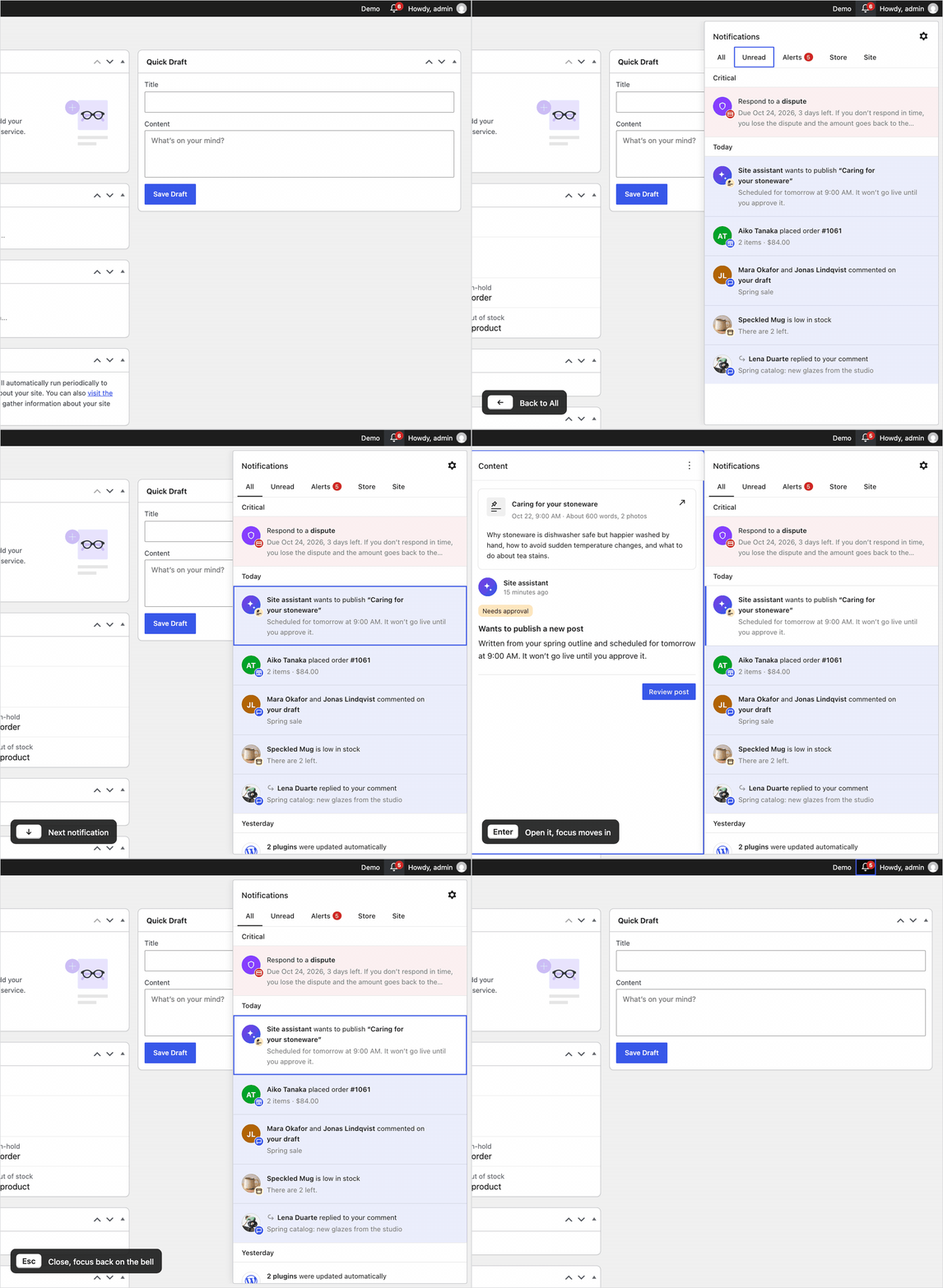
Each notification opens to show what it’s about (an order, a post), who it’s from, and one clear next step.
Real problems stay on top until they’re dealt with. Everything else stays out of the way.
The design is inspired by the WordPress.com notifications panel by Ollie Rozdarz and the WordPress.com notifications team, tested and refined with millions of people every day.
What this is, and isn’t
What this is: a new way to reach people. One notification tray, available not only on certain admin pages like today’s notices, but everywhere: every admin screen, inside the editor, and on the front of the site. Plugins that use it get their message across consistently, instead of resorting to bigger and bigger notices that push the page down. It comes with a design direction and a set of rules, so notifications look and behave the same whoever sends them.
What this isn’t: a breaking change. Existing plugins keep working, and no APIs or hooksHooksIn WordPress theme and development, hooks are functions that can be applied to an action or a Filter in WordPress. Actions are functions performed when a certain event occurs in WordPress. Filters allow you to modify certain functions. Arguments used to hook both filters and actions look the same. are being removed. Admin notices, custom ones included, will still work. They’re just not where notifications in WordPress are heading. It also isn’t finished, or all for 0.3.0.
A clearer system
This is the second version of the prototype. The first showed the idea. Early feedback asked how much is the system and how much is left to each plugin, so the second is about rules (what changed):
Plugins send data, not layout. They pick one of four layouts and fill its fields: Standard, Object (with a card for what it’s about), Conversation and Group.
Five separate dimensions, each changing something different. A dispute, for example, is a payment (type), critical (severityseverityThe seriousness of the ticket in the eyes of the reporter. Generally, severity is a judgment of how bad a bug is, while priority is its relationship to other bugs.), operational (intent) and unread (read state), with the sender’s status “Needs response”, later “Won”. CoreCoreCore is the set of software required to run WordPress. The Core Development Team builds WordPress. owns the values; plugins choose from them.
Critical is rare and visible. It stays on top and turns the bell’s count red until it’s resolved, not just read.
An Alerts tab gathers critical notifications and warnings in one place, with a count, so what needs attention is always one click away. Warnings wait there until they’re dealt with.
Limits against noise. Repeats replace each other, many of the same become one, and tips and offers can all be turned off at once.
All of this is laid out in the catalog: System has the dimensions, layouts and rules, and Styles shows each part, from the badges and row states to the bell itself.
This version also adds a few smaller things people asked for. Density, in the ⚙ menu under Appearance, switches between comfortable and compact: one line per row, so busy sites see twice as many at once. Notifications can also be marked as unread from their ⋮ menu.
Open questions
These are open, and feedback on them is especially welcome.
Badges: one per type, or a few kinds?
Today each type of notification has its own small badge on the row: a speech bubble for comments, an order icon, a bar chart for stats. That’s what WordPress.com does, and it’s quick to scan. But the list grows every time a plugin brings something new, like bookings or form entries. The alternative is a few generic badges that never grow (message, reaction, activity, system, milestone, tip), with the specifics shown in the circle and the title instead. Which works better as more plugins join? Both are compared in the catalog.
Severity: are three values enough?
Severity decides what stands out. Critical is pinned at the top and turns the bell’s count red, warnings wait in the Alerts tab, and info is everything else. There’s no “success”: good news already shows in the status, like a dispute marked “Won”. Core’s docs suggest alert, warning and info, close to this. Are three values enough, and who decides which notifications are allowed to be critical?
Who did it and what it’s about: optional extras, or proper fields?
To show who did something (a customer’s name and picture) and what it’s about (a card for the order), a notification needs two pieces of data core doesn’t store today. They can go in core’s existing meta column, as actor and about, without changing the database. But that keeps them optional and loosely defined. Should they stay in meta, or become proper fields every plugin fills the same way?
Across channels: where should each event arrive?
The same event can reach someone in several ways: the bell, a count in the admin menu, an email, a push to their phone. A new order today does three of these, and could do four if Orders gets its own menu item with a count. Which events belong where, so each arrives once, in the right place? This needs a review of every event, not just the bell.
Unread: a tab, or a filterFilterFilters are one of the two types of Hooks https://codex.wordpress.org/Plugin_API/Hooks. They provide a way for functions to modify data of other functions. They are the counterpart to Actions. Unlike Actions, filters are meant to work in an isolated manner, and should never have side effects such as affecting global variables and output.?
I’d keep a top-level Unread tab, even though it mixes read state in with the categoryCategoryThe 'category' taxonomy lets you group posts / content together that share a common bond. Categories are pre-defined and broad ranging. tabs, because it’s what people most often want to see. For comparison, the demo also has Show only unread, a filter that works within any tab, so you can see what’s unread in Store, for example. To try it, open Demo in the admin bar › Unread › In the gear menu, then the bell’s ⚙ menu › Show only unread.
Settings: how do they scale?
People can mute notifications per channel, like WooCommerce › Orders, and turn off each plugin’s tips with one switch. With many plugins, each sending several kinds, that list gets long fast. How should settings stay manageable? This hasn’t been explored yet.
AccessibilityAccessibilityAccessibility (commonly shortened to a11y) refers to the design of products, devices, services, or environments for people with disabilities. The concept of accessible design ensures both “direct access” (i.e. unassisted) and “indirect access” meaning compatibility with a person’s assistive technology (for example, computer screen readers). (https://en.wikipedia.org/wiki/Accessibility): does the keyboard work for you?
The keyboard follows the WordPress.com panel: arrows move through the list, Enter opens a notification and moves focus into it, Esc goes back to the same row, and Esc again closes the bell. Here’s a short GIF of it in action. Does it work well with screen readers and other assistive technologyAssistive technologyAssistive technology is an umbrella term that includes assistive, adaptive, and rehabilitative devices for people with disabilities and also includes the process used in selecting, locating, and using them. Assistive technology promotes greater independence by enabling people to perform tasks that they were formerly unable to accomplish, or had great difficulty accomplishing, by providing enhancements to, or changing methods of interacting with, the technology needed to accomplish such tasks.
https://en.wikipedia.org/wiki/Assistive_technology?
Stress-testing the system against other plugins. WooCommerce was the first deep test. Next, more plugins’ notices go through the same catalog, starting with Jetpack, to see how they fit and where the rules need to change.
A first step in 0.3.0: shaping what core’s first hub can show, so it already moves in this direction.
When could this ship?
Not soon, and that’s fine. 0.3.0 comes first, as a feature pluginFeature PluginA plugin that was created with the intention of eventually being proposed for inclusion in WordPress Core. See Features as Plugins, and merging into core follows after it. Plugins can only adopt notifications once they’re in WordPress, and and moving over is up to each plugin, at its own pace. Jonathan’s weekly updates follow the plan. There’s time for feedback to shape this.
Feedback
Your feedback is welcome, whether you use WordPress, build plugins that send notifications today, or work on accessibility. Leave a comment on this post, or on issue #655, where the work continues. You can also find us in #feature-notifications on SlackSlackSlack is a Collaborative Group Chat Platform https://slack.com/. The WordPress community has its own Slack Channel at https://make.wordpress.org/chat/.
Props @jameskoster for early feedback, @joen for guidance, and @keoshi for earlier explorations into notifications.
This week was more of a maintenance week: 24 PRs merged, 23 of them Dependabot updates, The more interesting activity is in review: 16 new contributor PRs opened this week.
Highlights
README now points to the demo pluginPluginA plugin is a piece of software containing a group of functions that can be added to a WordPress website. They can extend functionality or add new features to your WordPress websites. WordPress plugins are written in the PHP programming language and integrate seamlessly with WordPress. These can be free in the WordPress.org Plugin Directory https://wordpress.org/plugins/ or can be cost-based plugin from a third-party. (#648, @psykro): adds a note telling developers where to find the demo code plugin for trying out the feature.
Big dependency catch-up: 23 Dependabot PRs merged, with support from @masteradhoc, including a grouped update of 37 @wordpress/* packages (#598). Another 17 stale Dependabot PRs were closed without merging (usually because a newer version replaced them).
Strong contributor pipeline: open PRs now cover the REST APIREST APIThe REST API is an acronym for the RESTful Application Program Interface (API) that uses HTTP requests to GET, PUT, POST and DELETE data. It is how the front end of an application (think “phone app” or “website”) can communicate with the data store (think “database” or “file system”)
https://developer.wordpress.org/rest-api/ (GET, POST, and DELETE on notifications), a schema v2 with a design write-up, user-scoped repositories, UTC date handling, and npm script fixes.
httpHTTPHTTP is an acronym for Hyper Text Transfer Protocol. HTTP is the underlying protocol used by the World Wide Web and this protocol defines how messages are formatted and transmitted, and what actions Web servers and browsers should take in response to various commands.-proxy-middleware
serialize-javascriptJavaScriptJavaScript or JS is an object-oriented computer programming language commonly used to create interactive effects within web browsers. WordPress makes extensive use of JS for a better user experience. While PHP is executed on the server, JS executes within a user’s browser.
https://www.javascript.com
Every individually listed bump is a minor or patchpatchA special text file that describes changes to code, by identifying the files and lines which are added, removed, and altered. It may also be referred to as a diff. A patch can be applied to a codebase for testing. release; the @wordpress/* group is in #598.
In progress
REST API
#640 feat(rest): add GET /notifications/{id} (faisalahammad)
#638 docs: add database schema design post (faisalahammad)
#626 fix: make notification repository user-scoped (elphizu)
#627 Model: Handle dates in UTC and keep column fields out of message metaMetaMeta is a term that refers to the inside workings of a group. For us, this is the team that works on internal WordPress sites like WordCamp Central and Make WordPress. (huzaifaalmesbah)
#624 Framework: Store one Factory instance per subclass (huzaifaalmesbah)
#642 Channels: Fix namespace typo in includes/channels.php and add tests (devmuhib009)
UIUIUser interface / JSJSJavaScript, a web scripting language typically executed in the browser. Often used for advanced user interfaces and behaviors.
#645 Move hub settings link to a top cog (faisalahammad)
#633 fix: convert notification store to thunks (KhushalSainS)
#552 Types: add return type declaration to jsonSerialize methods (SirLouen), opened earlier and updated this week
Tooling & repo
#632 Tooling: Fix the test:php, php-install, lint:css and docGen npm scripts (huzaifaalmesbah)
#631 Tooling: Make lint:pkg-jsonJSONJSON, or JavaScript Object Notation, is a minimal, readable format for structuring data. It is used primarily to transmit data between a server and web application, as an alternative to XML. and lint:md:docs lint real files (huzaifaalmesbah)
#628GitHubGitHubGitHub is a website that offers online implementation of git repositories that can easily be shared, copied and modified by other developers. Public repositories are free to host, private repositories require a paid subscription. GitHub introduced the concept of the ‘pull request’ where code changes done in branches by contributors can be reviewed and discussed before being merged by the repository owner. https://github.com/: Add a Props Bot workflow (huzaifaalmesbah)
#625 GitHub: Update the pull request template (huzaifaalmesbah)
#647 npm: bump eslint from 10.4.0 to 10.13.0 (Dependabot)
This is the first in a series of weekly status update posts from the WP Feature Notifications work.
Security PRS
There are 30+ open Dependabot PRs that will resolve various dependency security alerts across the repository. It would be really helpful if any contributors have time to help review these PRs, or fix any merge conflicts (using the @dependabot rebase comment).
0.3.0 release tracking issue
GitHubGitHubGitHub is a website that offers online implementation of git repositories that can easily be shared, copied and modified by other developers. Public repositories are free to host, private repositories require a paid subscription. GitHub introduced the concept of the ‘pull request’ where code changes done in branches by contributors can be reviewed and discussed before being merged by the repository owner. https://github.com/issue #302 has been updated to include any open (and newly created) issues that will make the 0.3.0 (aka MVPMinimum Viable Product"A minimum viable product (MVP) is a product with just enough features to satisfy early customers, and to provide feedback for future product development." - WikiPedia) release possible. This tracking issue now lists the 16 open items required for the 0.3.0 release.
All development work toward releasing 0.3.0 will focus on these 16 open issues, and contributors are invited to focus their efforts on them.
Feature Notifications is the project exploring a unified notifications system for WordPress (#43484). It has been quiet since version 0.2.0 shipped in April 2023. This post covers where the project stands today and the plan to get to version 0.3.0, with the goal of shipping 0.3.0 alongside the WordPress 7.2 release in December.
Why 0.3.0 matters
The 0.3.0 milestone was always meant to be the first live preview: a working system that creates, stores, displays, and dismisses notifications. That makes 0.3.0 the project’s first functional MVPMinimum Viable Product"A minimum viable product (MVP) is a product with just enough features to satisfy early customers, and to provide feedback for future product development." - WikiPedia rather than a maintenance release.
Where things stand
I’ve spent some time auditing the codebase and putting together a detailed release plan. In short:
The foundations are solid. The data models, factories, channel registry, and database schema are well designed and have unit tests. The notification hub UIUIUser interface in the adminadmin(and super admin) bar is in place.
The system isn’t wired up end to end yet. The persistence layer is still a set of stubs, the REST APIREST APIThe REST API is an acronym for the RESTful Application Program Interface (API) that uses HTTP requests to GET, PUT, POST and DELETE data. It is how the front end of an application (think “phone app” or “website”) can communicate with the data store (think “database” or “file system”)
https://developer.wordpress.org/rest-api/ returns empty responses, dismissing a notification doesn’t save anything, and the REST controller tests are skipped. A few subtle bugs (in the schema, the factory, model serialization, and the client-side data store) mean wiring things up isn’t enough. They need fixing first.
The release tooling has drifted. Version numbers disagree across files, the readme and changelog are out of date, internationalization doesn’t work end to end, and some CI checks pass without testing anything.
Recent maintenance: the tooling has been brought in line with current WordPress standards (#559), and dependencies are up to date.
Major Kudos
It would be remiss of me not to share massive kudos and thanks to the contributors who stepped in to keep the project moving when I had to step away in 2023, especially @sephsekla, @bitmachina, and @erikyo, and everyone who has contributed to the project so far. I hope you can all join in some way as we work toward getting this merged into coreCoreCore is the set of software required to run WordPress. The Core Development Team builds WordPress..
Next steps
The work is split into phases, and much of it can happen in parallel:
Clean up the workspace.TriagetriageThe act of evaluating and sorting bug reports, in order to decide priority, severity, and other factors. the open pull requests, including the existing polling PR (#397), and move the relevant issues into the 0.3.0 milestone.
Build the MVP. Ship a schema update with a working upgrade path, implement the notification and subscription repositories, add a PHPPHPThe web scripting language in which WordPress is primarily architected. WordPress requires PHP 7.4 or higherAPIAPIAn API or Application Programming Interface is a software intermediary that allows programs to interact with each other and share data in limited, clearly defined ways. for emitting notifications to a channel, flesh out the REST endpoints with a proper capabilitycapabilityA capability is permission to perform one or more types of task. Checking if a user has a capability is performed by the current_user_can function. Each user of a WordPress site might have some permissions but not others, depending on their role. For example, users who have the Author role usually have permission to edit their own posts (the “edit_posts” capability), but not permission to edit other users’ posts (the “edit_others_posts” capability). model, fix the client-side store, and add polling and persistent dismissal. A WP-CLIWP-CLIWP-CLI is the Command Line Interface for WordPress, used to do administrative and development tasks in a programmatic way. The project page is http://wp-cli.org/https://make.wordpress.org/cli/ command to seed sample notifications will make all of this easier to test.
Fix correctness and security issues. These include an open permission check on the subscriptions endpoint, output escaping, URLURLA specific web address of a website or web page on the Internet, such as a website’s URL www.wordpress.org validation on notification actions, and timezone handling.
Get internationalization working, from text domains through to generating the .pot file and shipping translations in the zip.
Tidy up the release. Align version numbers, set minimum requirements to WordPress 6.7 and PHP 8.1, write the changelog, and fix the release workflow and test matrix.
Release 0.3.0 as a GitHubGitHubGitHub is a website that offers online implementation of git repositories that can easily be shared, copied and modified by other developers. Public repositories are free to host, private repositories require a paid subscription. GitHub introduced the concept of the ‘pull request’ where code changes done in branches by contributors can be reviewed and discussed before being merged by the repository owner. https://github.com/ release, submit it to the WordPress.orgWordPress.orgThe community site where WordPress code is created and shared by the users. This is where you can download the source code for WordPress core, plugins and themes as well as the central location for community conversations and organization. https://wordpress.org/pluginPluginA plugin is a piece of software containing a group of functions that can be added to a WordPress website. They can extend functionality or add new features to your WordPress websites. WordPress plugins are written in the PHP programming language and integrate seamlessly with WordPress. These can be free in the WordPress.org Plugin Directory https://wordpress.org/plugins/ or can be cost-based plugin from a third-party. directory, and invite everyone to start testing.
You can find more details about the release plan in this Markdown document, which will help focus the work that needs doing.
The target date for this release is 1 December 2026, to align with the final WordPress 7.2 RCrelease candidateOne of the final stages in the version release cycle, this version signals the potential to be a final release to the public. Also see alpha (beta)..
Get involved
If you’d like to help, whether through code, testing, design feedback, or reviewing pull requests, join the #feature-notifications channel in Making WordPress Slack. I’ll post regular updates there as the work moves forward, and it’s the best place to find out where help is needed. You can also follow along on the GitHub repository.
In order to ensure our solution solves the right problems, and to and steer the future direction of the project, the WP Feature Notifications team is looking for feedback on the current system of notices within the WordPress dashboard.
While the scope of this project involves all forms of notifications (both adminadmin(and super admin) notices and emails), this survey will focus on the experience within the WordPress admin. The team would greatly value any input, both positive and negative.
There was some discussion during the meeting around visibility; several new contributors were not aware of the project before the Contributor Day. How can we address this as the project?
@Sephsekla to work to post more on the Make CoreCoreCore is the set of software required to run WordPress. The Core Development Team builds WordPress.blogblog(versus network, site), with both meeting notes and other updates
How else can we promote the project? Potentially work with other media, e.g. news sites and podcasts.
Everyone is encouraged to spread awareness, this doesn’t need to be @Sephsekla‘s area only.
Hopefully the upcoming survey will spread awareness as well.
Notifications survey
At WCEU Contributor Day, @terragirl worked on a survey on the current notices/notifications experience within WordPress.
This can inform our direction/user stories.
It will also provide potential marketing stats, and raise awareness of the project.
Some concerns around data and GDPR, do we want to collect emails to follow up?
The consensus is that this should be removed, it’s largely unnecessary and adds unnecessary risk.
This better integrates and builds upon existing WP Core components.
It should make maintenance easier, as well as better fitting with the ongoing development of the Dashboard.
This lead to some discussion about how we will handle notifications which are important but ephemeral – do we want to introduce some kind of toast component to the system?
Splitting the project
In Split this project between the API and Hub #339@dartiss proposed splitting the project, with the data model and APIAPIAn API or Application Programming Interface is a software intermediary that allows programs to interact with each other and share data in limited, clearly defined ways. in one feature pluginFeature PluginA plugin that was created with the intention of eventually being proposed for inclusion in WordPress Core. See Features as Plugins and the hub in another.
This would allow easier adoption of the new API without finalising the UIUIUser interface for the dashboard
However there are some concerns about how to handle display if we don’t include the new UI by default
The hub could be the default solution, but pluggable and easily disabled, so any custom solution can take over with the same API calls (e.g. Calypso).
AccessibilityAccessibilityAccessibility (commonly shortened to a11y) refers to the design of products, devices, services, or environments for people with disabilities. The concept of accessible design ensures both “direct access” (i.e. unassisted) and “indirect access” meaning compatibility with a person’s assistive technology (for example, computer screen readers). (https://en.wikipedia.org/wiki/Accessibility) review planning
We have a number of A11yAccessibilityAccessibility (commonly shortened to a11y) refers to the design of products, devices, services, or environments for people with disabilities. The concept of accessible design ensures both “direct access” (i.e. unassisted) and “indirect access” meaning compatibility with a person’s assistive technology (for example, computer screen readers). (https://en.wikipedia.org/wiki/Accessibility) tickets open at present.
It would be good to have a full audit of the UI before we continue much further, to ensure we are fully accessible from launch.
This would be a good opportuniy to work with the Accessibility Team.
Reduction of repository/endpoint scope for 0.3.0 release
@bitmachina had previously recommended reducing the scope of the endpoints for our next release.
However with the addition of new contributors, this may no longer be necessary. @terragirl is now also working on the REST endpoints, so we will process on all of them and reevaluate as necessary.
The WP Feature Notifications project will be at WordCampWordCampWordCamps are casual, locally-organized conferences covering everything related to WordPress. They're one of the places where the WordPress community comes together to teach one another what they’ve learned throughout the year and share the joy. Learn more. Europe Contributor DayContributor DayContributor Days are standalone days, frequently held before or after WordCamps but they can also happen at any time. They are events where people get together to work on various areas of https://make.wordpress.org/ There are many teams that people can participate in, each with a different focus. https://make.wordpress.org/support/handbook/getting-started/getting-started-at-a-contributor-day/, led by @sephsekla. We are a small, focused team, and always on the lookout for new contributors, so we would encourage anyone to get involved!
WP Feature Notifications is a feature pluginFeature PluginA plugin that was created with the intention of eventually being proposed for inclusion in WordPress Core. See Features as Plugins, with a proposal to modernise the way in which WordPress handles emails, adminadmin(and super admin) notices and user notifications. We are working towards the MVPMinimum Viable Product"A minimum viable product (MVP) is a product with just enough features to satisfy early customers, and to provide feedback for future product development." - WikiPedia version of a new, centralised system, with both PHPPHPThe web scripting language in which WordPress is primarily architected. WordPress requires PHP 7.4 or higher and REST-based APIs.
Contributing
The project has something for everyone, and all new contributors are very welcome!
For developers and other more technical contributors, we have several areas to focus on:
In-progress PHP work for the MVP
JavaScriptJavaScriptJavaScript or JS is an object-oriented computer programming language commonly used to create interactive effects within web browsers. WordPress makes extensive use of JS for a better user experience. While PHP is executed on the server, JS executes within a user’s browser.
https://www.javascript.com improvements to make better use of WordPress components
A provisional TypeScript rewrite of the JavaScript UIUIUser interface
We also have a number of areas to cover which are less technically focused:
Testing and feedback on our current proof of concept (version 0.2.0)
Feedback and pain points on the current WordPress notices and emails
Discussion and ideas for future requirements
No setup ahead of the event or prior knowledge is needed to get involved, but for more technical work we would recommend bringing a laptop with Docker, npm and Composer installed.
A pretty quiet week for the project, the key contributors have all been very busy.
@Sephsekla is working on a post for Make CoreCoreCore is the set of software required to run WordPress. The Core Development Team builds WordPress. around user stories and the problems this should solve, aiming to have that out by the next meeting.
@erikyo and @bitmachina are working on the MVPMinimum Viable Product"A minimum viable product (MVP) is a product with just enough features to satisfy early customers, and to provide feedback for future product development." - WikiPedia and switch to TypeScript, no major change
Review of project goals and priorities
@erikyo and @Sephsekla discussed high level goals and current priorities for the project
Create an extensibleExtensibleThis is the ability to add additional functionality to the code. Plugins extend the WordPress core software. notification system with PHPPHPThe web scripting language in which WordPress is primarily architected. WordPress requires PHP 7.4 or higher and REST APIs in WordPress
Improve the admin_notices experience by standardising notices through the new system, making things more accessible
Create an easier and more robust way for plugins/core to notify users by email, replacing the traditional use of wp_mail
Give both users and developers more choice of how notifications are delivered
Discussed the use case of improving email notifications:
This was always a stated goal early on, but we’ve been more focused on dashboard notifications recently
Once the PHP APIAPIAn API or Application Programming Interface is a software intermediary that allows programs to interact with each other and share data in limited, clearly defined ways. is in place, it should be straightforward to add this as a connector for notification channels – this will be a good test case for adding additional implementations
Current priorities
Communication and community engagement, e.g. Make Core post re: user stories
Complete in-progress MVP work (functional database, PHP API, hooked up to REST endpoints)
Complete TypeScript rewrite (since the JSJSJavaScript, a web scripting language typically executed in the browser. Often used for advanced user interfaces and behaviors. codebase is fully typed already, this shouldn’t run into issues)
Plan for upcoming events
Upcoming events discussions: WCEU and WCUS
It’s unclear whether we will have MVP ready for WCEU/WCUS. We’ll evaluate at our next meeting.
WCEU is probably too close to have 0.3.0 ready, but WCUS may be doable.
@Sephsekla will be running a contributor dayContributor DayContributor Days are standalone days, frequently held before or after WordCamps but they can also happen at any time. They are events where people get together to work on various areas of https://make.wordpress.org/ There are many teams that people can participate in, each with a different focus. https://make.wordpress.org/support/handbook/getting-started/getting-started-at-a-contributor-day/ table at WCEU (hoping to be able to do the same at WCUS). What are plans for new contributors?
@erikyo: Unlikely that we can onboard new contributors onto the project to work on the MVP, can we find more granular work?
If we can have PHP API ready, contributors could test building integrations for notification channels (e.g. email, SMS)
Lots of opportunities outside code contribution:
Design discussion
Get feedback on existing prototype
Follow up on user stories work: talk to people about their pain points, suggestions
Collaborate with GutenbergGutenbergThe Gutenberg project is the new Editor Interface for WordPress. The editor improves the process and experience of creating new content, making writing rich content much simpler. It uses ‘blocks’ to add richness rather than shortcodes, custom HTML etc.
https://wordpress.org/gutenberg/ Team on Phase 3 work
We have an opportunity to work with the Gutenberg team on Phase 3 plans for the adminadmin(and super admin), we should make sure to have these conversations
Some good conversation around JS UIUIUser interface refactoring: As previously noted, there are a lot of custom components we could simplify by using existing components from @wordpress/icons and @wordpress/components.
A TBC agenda for next week’s meeting can be found at https://github.com/WordPress/wp-feature-notifications/discussions/328. If you’d like to suggest a topic, or upvote an existing topic, the team would welcome any input from new contributors! Alternatively, feel free to suggest topics to cover in the comments.
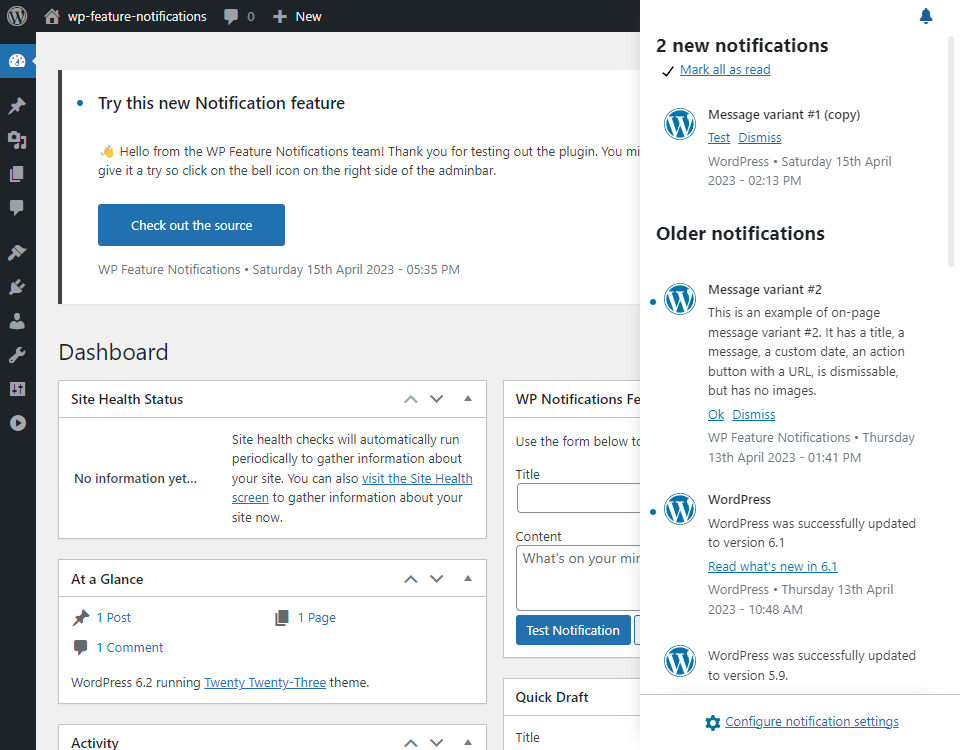
In the last few months we’ve had a good amount of progress, as well as a number of changes, which have led to the recent publication of prerelease 0.2.0.
0.2.0 – A robust JavaScriptJavaScriptJavaScript or JS is an object-oriented computer programming language commonly used to create interactive effects within web browsers. WordPress makes extensive use of JS for a better user experience. While PHP is executed on the server, JS executes within a user’s browser.
https://www.javascript.com system
You can test out the current state of the feature pluginFeature PluginA plugin that was created with the intention of eventually being proposed for inclusion in WordPress Core. See Features as Plugins by downloading the latest release at https://github.com/WordPress/wp-feature-notifications/releases/latest. Please note that you will need to be using WordPress 6.2 or above.
What originally started as a UX proof of concept has evolved into a more sophisticated JSJSJavaScript, a web scripting language typically executed in the browser. Often used for advanced user interfaces and behaviors.-based system for displaying notifications based on serialised data. At the moment this uses static dummy data, however in a future update this will interface with the upcoming REST controllers to display persistent data.
Props to @codekraft and @bitmachina for some exceptional work here, which has really progressed the project.
Leadership, planning and the team
After extensive work as project lead, @psykro has decided to step down from the role. On behalf of the whole team, I’d like to thank him for the massive contributions he’s made, and the time and effort he’s put into the project over the last few years. @sephsekla has taken over project leadership in his stead.
In addition to our weekly office hours (15:00 UTC on Wednesday), @sephsekla, @codekraft, @bitmachina and @jason_the_adams have started a monthly planning call, in order to better scope out the future of the projects
To support the project’s long-term goal of becoming part of WP CoreCoreCore is the set of software required to run WordPress. The Core Development Team builds WordPress., the team is looking for partnership from a core committercommitterA developer with commit access. WordPress has five lead developers and four permanent core developers with commit access. Additionally, the project usually has a few guest or component committers - a developer receiving commit access, generally for a single release cycle (sometimes renewed) and/or for a specific component., who can provide guidance on strategy as well as potential barriers to entry.
Core Feature vs Canonical PluginPluginA plugin is a piece of software containing a group of functions that can be added to a WordPress website. They can extend functionality or add new features to your WordPress websites. WordPress plugins are written in the PHP programming language and integrate seamlessly with WordPress. These can be free in the WordPress.org Plugin Directory https://wordpress.org/plugins/ or can be cost-based plugin from a third-party.
Matt’s post around Canonical Plugins late last year sparked some discussion as to whether this should be an option to consider for the future of the project. While this is a valuable concept, and indeed the approach taken for development, the team are in strong agreement that the update to notifications should be merged when ready, and not kept as a separate plugin.
WordPress is currently lacking a fundamental mechanism: sending notifications to users to give them feedback about state changes in the system.
Notification functionality is indeed fundamental, and already in constant use via the admin_notices hook, a workaround that has major issues of standardisation and accessibility. The new APIAPIAn API or Application Programming Interface is a software intermediary that allows programs to interact with each other and share data in limited, clearly defined ways. needs to be universal, and available by default, otherwise admin_notices will remain the de facto option.
GutenbergGutenbergThe Gutenberg project is the new Editor Interface for WordPress. The editor improves the process and experience of creating new content, making writing rich content much simpler. It uses ‘blocks’ to add richness rather than shortcodes, custom HTML etc.
https://wordpress.org/gutenberg/ Phase 3
The team was excited to see the upcoming evolution of the adminadmin(and super admin) experience, which was recently detailed in https://make.wordpress.org/core/2023/03/24/phase-3-collaboration/. As the WordPress dashboard continues to modernise, we are keen to play our part in improving the current admin_notices experience. It’s crucial to ensure that our designs and functionality mesh with the work being done here.
Roadmap and Next steps
The team has recently picked up momentum, but there is still much to be done in order to achieve the project’s goals. Currently the focus is on refining scope and transforming the demo into a minimum viable productMinimum Viable Product"A minimum viable product (MVP) is a product with just enough features to satisfy early customers, and to provide feedback for future product development." - WikiPedia (MVPMinimum Viable Product"A minimum viable product (MVP) is a product with just enough features to satisfy early customers, and to provide feedback for future product development." - WikiPedia). The upcoming 0.3.0 prerelease is planned to be a minimal, but functional notification system, with all demo content removed.
The next (and largest) piece of the puzzle is persistent database storage of notification data. We’re working on finalising the proposed schema, as well as discussing other issues such as retention, translations, multisitemultisiteUsed to describe a WordPress installation with a network of multiple blogs, grouped by sites. This installation type has shared users tables, and creates separate database tables for each blog (wp_posts becomes wp_0_posts). See also network, blog, site support and more.
As we move on to this major phase, the team would greatly welcome additional contributors onto the project, particularly developers specialising in PHPPHPThe web scripting language in which WordPress is primarily architected. WordPress requires PHP 7.4 or higher and SQL.
Expect a consultation and call for feedback on how we approach this database architecture soon!
Get involved
The project is always on the lookout for new contributors. If you would like to contribute to the project, we invite you to join the #feature-notifications channel in the Making WordPress Slack for our weekly office hours, every Wednesday at 15:00 UTC.
We will have a presence at the WordCampWordCampWordCamps are casual, locally-organized conferences covering everything related to WordPress. They're one of the places where the WordPress community comes together to teach one another what they’ve learned throughout the year and share the joy. Learn more. Europe Contributor DayContributor DayContributor Days are standalone days, frequently held before or after WordCamps but they can also happen at any time. They are events where people get together to work on various areas of https://make.wordpress.org/ There are many teams that people can participate in, each with a different focus. https://make.wordpress.org/support/handbook/getting-started/getting-started-at-a-contributor-day/, where we would love to see some new contributors. Regardless of skill set or expertise, Developers, designers, users or any other interested parties are very welcome!


You must be logged in to post a comment.