Welcome to the official blog for the Plugins Team.
The team acts as gate-keepers and fresh eyes on newly submitted plugins, as well as reviewing any reported security or guideline violations.
Quick Links
The team acts as gate-keepers and fresh eyes on newly submitted plugins, as well as reviewing any reported security or guideline violations.
Quick Links
X-comment from +make.wordpress.org/core: Comment on Introducing script attributes related functions in WordPress 5.7
Update from the PluginPlugin A plugin is a piece of software containing a group of functions that can be added to a WordPress website. They can extend functionality or add new features to your WordPress websites. WordPress plugins are written in the PHP programming language and integrate seamlessly with WordPress. These can be free in the WordPress.org Plugin Directory https://wordpress.org/plugins/ or can be cost-based plugin from a third-party. Review Team: This post is no longer being updated, so please use the guidelines and FAQ for any information you’re looking for.
Caveat: While this topic always brings up people arguing that the GPLGPL GPL is an acronym for GNU Public License. It is the standard license WordPress uses for Open Source licensing https://wordpress.org/about/license/. The GPL is a ‘copyleft’ license https://www.gnu.org/licenses/copyleft.en.html. This means that derivative work can only be distributed under the same license terms. This is in distinction to permissive free software licenses, of which the BSD license and the MIT License are widely used examples. means they can (and yes, you can copy GPL plugins and do whatever you want with them), we wish to remind developers that just because the GPL allows something doesn’t mean we will host it here. Our guidelines are considered above and beyond the GPL. After all, the GPL doesn’t say you can’t punch someone, but if you get into a fistfight at a WordCampWordCamp WordCamps are casual, locally-organized conferences covering everything related to WordPress. They're one of the places where the WordPress community comes together to teach one another what they’ve learned throughout the year and share the joy. Learn more., we’re not going to host your plugins.
Taking someone’s pay-for code and re-releasing it as free-of-charge is considered (by us — the Plugin Review Team) to be a form of piracy and is not welcome here. It doesn’t matter if the code is GPL, it matters that When you do that, when you copy and re-release someone’s code without any changes, you’re stealing the opportunity of the original developers to make a living, and we feel that is detrimental to the community. In addition, it’s often in violation of the terms you agreed to when you downloaded the plugin from the developer in the first place.
By you doing that, and rehosting here, you put the entire directory in peril. Arguably we become responsible for your actions. As such, we do not permit plugins that are sold off WordPress.orgWordPress.org The community site where WordPress code is created and shared by the users. This is where you can download the source code for WordPress core, plugins and themes as well as the central location for community conversations and organization. https://wordpress.org/ to be re-hosted here.
The only exception to this (besides it being your own plugin) is if you have made a significant fork, properly credited in the readme and inline code, and everything was 100% GPL compatible, including the terms from where you bought the plugin. If you pirated a plugin, or if you violated the license purchasing terms (which may say things like you cannot resell it), then we cannot host the code.
Edit: It’s important to note that adding non-GPL compliant terms to a license may in fact invalidate the license, which means we can’t host it here anyway. The above comment is not in support of people violating licenses nor are we attempting to protect and help those people in any way. We are trying to point out that even if a license says it’s GPL, if it’s sold with terms that violate the GPL, it cannot be hosted here either. tl;dr? If the license or terms are sus, we can’t host it.
If the plugin is your own plugin and you just want to re-host here, we will do our best to validate that claim, and may pend your plugin while this is researched. We appreciate your patience when that happens.
If you feel someone took your plugin and hosted a copy of it here, please email plugins@wordpress.org with a link to the plugin as it’s hosted here, a link to your original plugin, and (if the plugin is hosted outside WordPress.org) attach a zip of the plugin so that we may compare the two.
Edited to add: This post is not about the GPL. This is only about the existing WordPress.org Plugin Developer Guidelines. You should not, under any circumstances, use this post to frame your understanding or interpretation of the GPL as it is not intended as such. Again, this post is about the plugin guidelines, the ones all plugin devs already committed to following, which have long since stated that immoral or ethical practices are not permitted here.
While we do look for plugins that touch the update services on submission, we do not monitor existing plugins, which is where this reminder stems from.
Unless your pluginPlugin A plugin is a piece of software containing a group of functions that can be added to a WordPress website. They can extend functionality or add new features to your WordPress websites. WordPress plugins are written in the PHP programming language and integrate seamlessly with WordPress. These can be free in the WordPress.org Plugin Directory https://wordpress.org/plugins/ or can be cost-based plugin from a third-party. has the purpose of managing updates, you must not change the defaults of WordPress’ update settings.
You may offer a feature to auto-update, but it has to honor the coreCore Core is the set of software required to run WordPress. The Core Development Team builds WordPress. settings. This means if someone has set their site to “Never update any of my plugins or themes” you are not to change those for them unless they opt-in and request it.
The reason for this is that plugins should not over-reach their authority. When a plugin is made, it is self-defined by the developers as what it will do and why. There are some logical reasons to expand that of course (an anti-spam comment plugin may grow to also handle feedback forms), but for most plugins, the arbitrary management of plugin updates is outside their stated goals.
Plugins crossing over purposes, overriding settings that are unrelated to the function of their specific goal, can and will cause unexpected outcomes. It also destroys the faith users have in you to not break their sites. Sadly, this happened recently to a well used plugin, and the fallout has been pretty bad.
We do understand that many plugins want to take advantage of the new features within WordPress. But if your plugin is a custom blockBlock Block is the abstract term used to describe units of markup that, composed together, form the content or layout of a webpage using the WordPress editor. The idea combines concepts of what in the past may have achieved with shortcodes, custom HTML, and embed discovery into a single consistent API and user experience., you really don’t have a need to be changing how the uploader works, or even setting your plugin to default-auto-update.
At this time, we have no plans to spell this out in a guideline. We do currently, regularly flag plugins that go outside their dictated (self defined) boundaries, and this is not a change. Please, respect your users.
In 2019, we transitioned to a new email service which has allowed us to make all emails anonymous. This decision was not initially well received by all, especially when people feel they are unfairly targeted for guideline violations, though over time it’s settled down.
I wanted to take a minute to explain the backstory about why this had to happen.
Over the last four years, there has been a disturbing escalation in behavior with regards to plugins. Reviewers have found themselves targeted in rather terrifying ways, including:
All those things happened from people who were censured for not complying with the guidelines. Some of them even chose to quit, asking us to pull their plugins, and then retaliated in that manner.
Their reactions are always rather odd to look at in the community because the PluginPlugin A plugin is a piece of software containing a group of functions that can be added to a WordPress website. They can extend functionality or add new features to your WordPress websites. WordPress plugins are written in the PHP programming language and integrate seamlessly with WordPress. These can be free in the WordPress.org Plugin Directory https://wordpress.org/plugins/ or can be cost-based plugin from a third-party. Team does not publicize these issues. That is to say, we generally will not explain, to the general public, the full details on why something was closed or a developer banned. We don’t do this to hide anything for our own benefit, though that appears to be a common misconception. The reason we keep those issues private is that we feel it gives developers a chance to walk back from a very bad day.
We know we’re sending out some pretty devastating emails to people. Being told “Your plugins have been closed” is a gut-punch, and it’s one we really try to avoid. When people are hurt, they have a tendency to lash out, and in doing so they can cause irreparable harm to their own standing in society. The Internet never forgets anything, and the words said in anger and frustration will haunt us to our dying day and beyond.
By keeping the conversations private, we are allowing developers to have the ability to survive their bad day. You can think of it as giving people a second chance. Of course, you can’t help everyone, and we do know to cut our losses. Not everyone will come back, and some people will burn bridges so badly that it would be detrimental to the community at large to allow it, no matter how much they apologize.
2019 was the worst year on record for categorical abuse of the members of the team. It’s difficult to express without violating confidence (and in some situations, legal cases still pending) exactly how bad. When we say ‘Someone mailed things to a reviewer’ we literally do mean that unasked for items were sent via physical mail. And when we say that someone’s home address was leaked, it was absolutely done with intent to harm.
All this leads to the great cost we bear, willingly, as we shoulder the outrage quietly. When we had people’s real names attached to the emails, we had them targeted specifically and personally. They were clear attacks on people, many times misguided and misdirected, that prompted us to change the emails to anonymous.
Because of the attacks on people’s safety and out of a desire to protect their health and well being, we have chosen to make all emails from the Plugin Review Team anonymous.
This choice has not really gone over as well as we’d hoped.
It’s no secret that people get very passionate about their plugins. They’ve created something out of their heart and minds, and getting emails from us telling them that there are issues with their work is disheartening. It’s worse when those are clearly a form email.
When we moved to form replies years ago, in order to expedite the review process, they were generally understood to be the cost of the high volume of reviews. Having impersonal emails sent from a real human was annoying, but acceptable. Having impersonal emails sent from an anonymous account makes us feel like we’re not valued as humans.
That’s why we’ve worked hard to rewrite a lot of the emails to be more clear about what the problem is and what you need to do to resolve it. We’ve tried to make our dreaded ‘Final Warning’ email even more clear.
We want nothing more than the continued success of the Plugin Ecosystem, hosted on WordPress.orgWordPress.org The community site where WordPress code is created and shared by the users. This is where you can download the source code for WordPress core, plugins and themes as well as the central location for community conversations and organization. https://wordpress.org/ and not. When we’re reviewing your code, we want the code to be safe and to be well documented so that you have every possible opportunity to be a success.
We can no longer sacrifice ourselves in doing so.
Our emails are always sent by a real human being, who is just as flawed as you are. They’re never personal attacks. While we always do our best to make sure we’re in the right before we send a warning, we are humans, like you, and we make mistakes.
With rare exceptions, emails from plugins will remain anonymous. In some cases, the person replying may divulge who they are, but that is their personal choice to do so. No one on the team will ever be required to reveal their identity in an email.
We hope you can understand this frustrating, but needed, action.
#abuse, #explanation, #privacyWell. It’s been a year…
Between December 31 2019 and December 28 2020, we have:
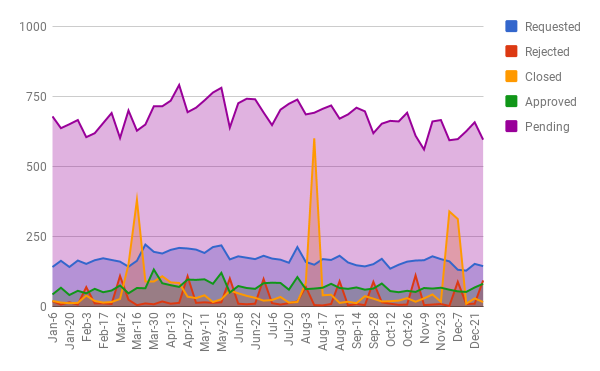
It’s not a huge increase in workload, and unlike last year, we have only three spikes of massive closures.
Here’s an overview in table format:
| Requested | Rejected | Closed | Approved | Pending | |
| Most in a week | 221 | 111 | 600 | 132 | 790 |
| Least in a week | 128 | 2 | 10 | 41 | 560 |
| Average | 169 | 28 | 65 | 69 | 676 |
| YEAR TOTAL | 8486 | 1338 | 3317 | 3451 | 595 |
Overall, the load was slightly up but nothing to phone homePhone home A plugin that “phones home” sends back tracking information to the plugin developer once it’s installed on a site. This may include IP addresses, usernames, or other data. about.
The number one reason a pluginPlugin A plugin is a piece of software containing a group of functions that can be added to a WordPress website. They can extend functionality or add new features to your WordPress websites. WordPress plugins are written in the PHP programming language and integrate seamlessly with WordPress. These can be free in the WordPress.org Plugin Directory https://wordpress.org/plugins/ or can be cost-based plugin from a third-party. is closed is, still, bounced emails. The number two reason is security, followed by general guidelines and trademarks.
The number one reason a plugin is pended for approval is sanitization/validation related (remember you have to do both – sanitize and validate – because otherwise people will put ‘dog’ in for a value of how many hats they need).
We had some wins and some losses.
First, here’s what didn’t go great:
Now here’s what did go well!
As mentioned last year, we make heavy use of Saved Replies to speed up reviews and processing. Here again, in order from most used to least, are the most commonly used replies:
These are sent out during reviews to help identify issues:
These are the most common reasons a plugin was rejected:
The top three reasons a plugin is pended before we even review it:
These are common replies to common issues.
With the release of the 5.6 field guide comes the email.
If you are a pluginPlugin A plugin is a piece of software containing a group of functions that can be added to a WordPress website. They can extend functionality or add new features to your WordPress websites. WordPress plugins are written in the PHP programming language and integrate seamlessly with WordPress. These can be free in the WordPress.org Plugin Directory https://wordpress.org/plugins/ or can be cost-based plugin from a third-party. developer and did not receive the email, please double check the email address in the user account that has commit access to the plugin.
Also please keep in mind, if your email bounces or we receive auto-replies after previously warning you, your plugin will be closed until you resolve this issue.
X-comment from +make.wordpress.org/core: Comment on WordPress and PHP 8.0
X-comment from +make.wordpress.org/core: Comment on Facebook and Instagram embeds to be deprecated October 24th
X-comment from +make.wordpress.org/support: Comment on Talking point: Handling support for commercial users on the WordPress forums
X-comment from +make.wordpress.org/core: Comment on Proposal: Dropping support for old PHP versions via a fixed schedule

