Emoji locale (art-xemoji): how would you translate weekdays and months?

A few of us have recently started reviving the Emoji localeLocale Locale = language version, often a combination of a language code and a region code, for instance es_MX denotes Spanish as it’s used in Mexico. A list of all locales supported by WordPress in https://make.wordpress.org/polyglots/teams/ (art-xemoji). It’s been dormant for years, originally set up as a testing range for platform work rather than a locale anyone would use, so it has no active conventions and no maintainer. CoreCore Core is the set of software required to run WordPress. The Core Development Team builds WordPress. sits at about 4%.

We’re now trying to give it a coherent system, and we’d like input from people who translate into languages other than English.

What this “language” is

Some constraints, so the question makes sense:

Vocabulary is 27 words. That’s the entire official glossary. Everything else has to be invented or left in English.
No plurals. Declared nplurals=1, like Japanese or Korean.
No inflection, no tense, no articles. Emoji have no morphology.
Word order is currently English. Not by design, just because whoever translated first worked from English. Nothing stops us changing it.
No phonetics. A reader can’t sound anything out. If a symbol isn’t recognisable on sight, it carries nothing.

So it behaves like a highly isolating language with a 27-word lexicon and a writing system where every character is a picture.

The question

How would you translate weekday and month names into a language like that?

One thing we’ve had to abandon early: the idea that a “culturally neutral” option exists. Emoji originated in Japan, and the early sets are full of Japanese cultural symbols that were carried into Unicode more or less intact (🎍 kadomatsu, 🎎 hina dolls, 🎏 koinobori, 🎑 tsukimi). Choosing emoji is choosing culture, whether or not we intend to.

So the useful test seems to be recognisability rather than neutrality: can someone outside the originating culture reconstruct the meaning?

By that test:

🎄 for December probably works. Christmas is widely legible even where it isn’t celebrated.
🎍 for January doesn’t, outside Japan. It reads as “some plant”.
❄️ for January fails differently: it’s perfectly legible, but wrong for everyone in the southern hemisphere, which is what the currently approved stringsString A string is a translatable part of the software. A translation consists of a multitude of localized strings. use (January → ❄️1️⃣, August → ☀️8️⃣).

For weekdays there’s a candidate that scores well on this test: the classical planetary mapping (☀️🌙🔥💧🌳⭐🌍). Not because it’s neutral, but because it’s already shared very widely. The Babylonian planetary week spread west into Greek and Latin and east into Persian, Indian, Chinese and Japanese, so French mardi and Japanese 火曜日 line up one to one. English is the outlier, having swapped in Norse gods.

For months, the closest equivalent is the zodiac (♈♉♊♋♌♍♎♏♐♑♒♓). Twelve signs, one per month, astronomically defined so no hemisphere flip, and the same Babylonian lineage as the weekday planets. Recognisability is mixed: the symbols are widely known in some regions and near-invisible in others, and they carry associations with astrology that not everyone will welcome. One caveat: zodiac periods don’t align with month boundaries (Aries runs 21 March to 19 April), so the mapping would be approximate rather than exact. But it’s the only twelve-item system we’ve found that doesn’t break in half the world.

What would help

If the weekday or month names in your language come from a system that isn’t Roman or Christian in origin, we’d like to hear about it. Lunar calendars, agricultural cycles, numbered months, animal cycles, anything. We’re looking for a system that enough people can reconstruct, and the Roman one clearly isn’t the only candidate.

Working notes: https://github.com/bissy/wp-emoji-locale-style-guide

Discussion in #polyglots-emoji on SlackSlack Slack is a Collaborative Group Chat Platform https://slack.com/. The WordPress community has its own Slack Channel at https://make.wordpress.org/chat/.

#reason-request

Message to Manjit

A message to @manjit07

Hi.
It has been brought to my attention that you regularly upload translations to a wide selection of target languages for a few translation projects.

As you probably know, everyone involved in the further handling of your translations are volunteers, who spend their time building and nurturing their respective locale teams. In many cases, these teams have enormous backlogs. See https://translate.wordpress.org/stats/ for some statistics.

If/when the localeLocale Locale = language version, often a combination of a language code and a region code, for instance es_MX denotes Spanish as it’s used in Mexico. A list of all locales supported by WordPress in https://make.wordpress.org/polyglots/teams/ teams check pending translations, their main goal is usually to help new translation contributors improve their quality. The locale teams don’t really offer any general “translation validation and fixing” service.

In the Polyglots’ handbook, it’s clearly stated that nobody should upload machine translations that haven’t been checked by someone who knows the target language really well (See https://make.wordpress.org/polyglots/handbook/translating/expectations/ ).

In short, by repeatedly uploading machine translations of questionable quality, you’re exploiting a limited resource of volunteer time. We kindly request that you don’t upload translations for languages you don’t personally know well.

If you continue in the same way, we may need to blockBlock Block is the abstract term used to describe units of markup that, composed together, form the content or layout of a webpage using the WordPress editor. The idea combines concepts of what in the past may have achieved with shortcodes, custom HTML, and embed discovery into a single consistent API and user experience. you completely from suggesting stringString A string is a translatable part of the software. A translation consists of a multitude of localized strings. translations in the future.

Please read https://make.wordpress.org/polyglots/handbook/plugin-theme-authors-guide/ for some ideas on how to better align your contributions with the Polyglots’ team.

If you’ve got any questions, feel free to comment under this post, or (better/nicer), join the global Slack team for WordPress contributors via https://make.wordpress.org/chat/ and then come to our Slack channel “polyglots” and say “Hi”.

#reason-request

WordPress 6.7 zh_CN packaging issues

Hello, our i18nInternationalization Internationalization (sometimes shortened to I18N , meaning “I - eighteen letters -N”) is the process of planning and implementing products and services so that they can easily be adapted to specific local languages and cultures, a process called localization. This is the process of making software translatable. Information about Internationalization for developers can be found in the Developer’s handbooks. svn https://i18n.svn.wordpress.org/zh_CN/branches/6.7/dist/ contains 3 localized files, but they do not appear in the installation package https://cn.wordpress.org/latest-zh_CN.zip, can you help us check why?

#reason-request

Message to @uki2017 about the…

Message to @uki2017 about the #kk translation of WordPress coreCore Core is the set of software required to run WordPress. The Core Development Team builds WordPress..
Hi, I looked through more than 1000 stringsString A string is a translatable part of the software. A translation consists of a multitude of localized strings. of your stringString A string is a translatable part of the software. A translation consists of a multitude of localized strings. for WordPress core, and they all seem to be in Russian, rather than Kazakh.
I was alerted about this via a comment on https://make.wordpress.org/polyglots/2017/04/07/hello-polyglots-i-am-the-85/ by @dnauryz

I’d like to invite both of you to join the global Slack team for WordPress contributors (which you do via https://make.wordpress.org/chat/ ) so that we can try to sort this out. You may reach out to me via direct message on Slack, or in the “polyglots” channel.

If anyone wants to use WordPress in Russian, then they can simply choose Russian as their site language.

You can also comment under this post.
PS! I happen to know Russian, so if you prefer Russian over English, that’s OK with me.

#reason-request

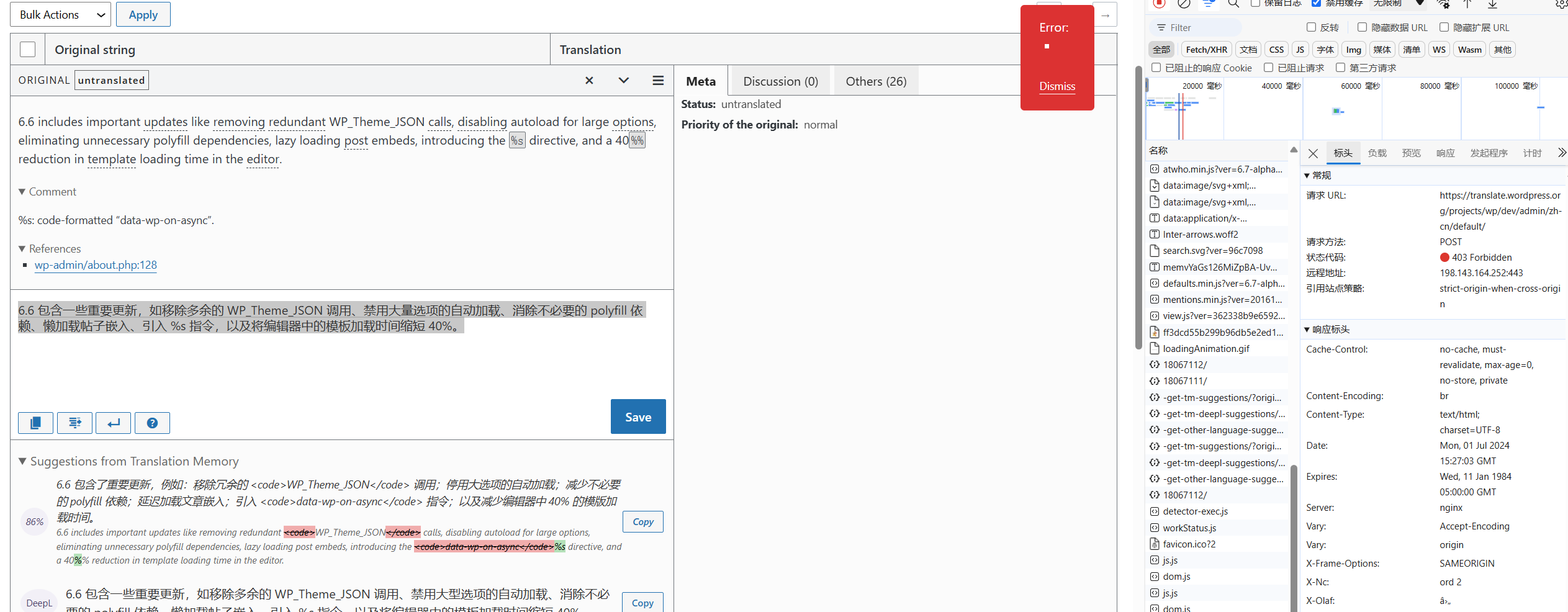
Translate WP 6.6 Administration return 403

Hello, Polyglots teamPolyglots Team Polyglots Team is a group of multilingual translators who work on translating plugins, themes, documentation, and front-facing marketing copy. https://make.wordpress.org/polyglots/teams/. When I try to translte WP 6.6 Administration project into zh_CN, I got an unexpected 403 problem. Can someone help me see why?

Original:

6.6 includes important updates like removing redundant WP_Theme_JSON calls, disabling autoload for large options, eliminating unnecessary polyfill dependencies, lazy loading post embeds, introducing the %s directive, and a 40%% reduction in template loading time in the editor.

Translation:

6.6 包含一些重要更新,如移除多余的 WP_Theme_JSON 调用、禁用大量选项的自动加载、消除不必要的 polyfill 依赖、懒加载帖子嵌入、引入 %s 指令,以及将编辑器中的模板加载时间缩短 40%。

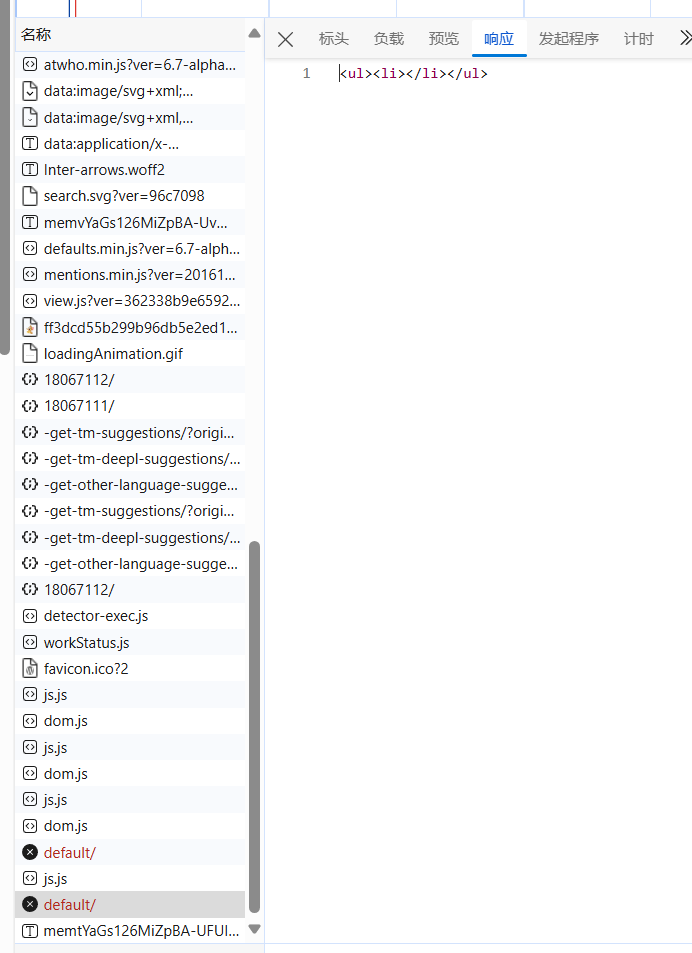
And Server return 403:

#reason-request

If I see that the…

If I see that the editor is stealing from my translation, how can I reactReact React is a JavaScript library that makes it easy to reason about, construct, and maintain stateless and stateful user interfaces. https://reactjs.org?

#reason-request

Hi I woild like to…

Hi I woild like to understand why the french translation of book review blockBlock Block is the abstract term used to describe units of markup that, composed together, form the content or layout of a webpage using the WordPress editor. The idea combines concepts of what in the past may have achieved with shortcodes, custom HTML, and embed discovery into a single consistent API and user experience. is not on line , since 2 months alls item ares translate
best

#reason-request